


Introduction
What did Jesus do before the age of 30? He grew up in Nazareth among ordinary people 🚣, listening to the Father in silence, helping with household tasks, working as a carpenter, living as everyone else did – yet remaining without sin in everything.
Table Of Content
- Introduction
- Why it is important to study His life not only after baptism, but also before it
- What we know for sure, and what we assume based on history, culture, tradition, and Scripture
- Sources for learning about the life of Jesus before the age of 30
- The Early Years of Jesus: From Birth 👩🍼 to Coming of Age 🧒
- Birth and Early Years
- Table: Key Events in the Early Childhood of Jesus
- Life in Nazareth
- The Teenage and Youth Years of Jesus
- The Gospel Account of the 12-Year-Old Jesus in the Temple
- His Upbringing and Education
- Studying the Torah, Manual Work, Family Duties
- He May Have Learned His Father’s Trade – Carpentry
- Summary table: The elements of Jesus’ upbringing
- The Profession of Jesus: Who He Was Before the Ministry Began
- “Carpenter” – what does it mean? Truths even from the cross
- Table: What a Tecton Did in the Time of Jesus
- The Meaning of Jesus’ Work for His Future Ministry
- Work as the Language of Parables
- The hidden years: what did Jesus do before the age of 30?
- Assumptions and hypotheses
- A time of inner growth 📈
- Prayer: the source of inner light
- Contemplation: seeing deeper
- Life among people: holiness in the hidden
- The Beginning of Public Ministry
- The Baptism of Jesus by John the Baptist
- The Symbolism of the Dove 🕊️ and the Voice from Heaven 🌤️
- The Beginning of a New Stage
- The Temptation in the Wilderness
- 40 Days of Fasting
- What did Jesus do during His public ministry?
- Preaching the Kingdom of God
- Miracles and Healings
- The choosing of the apostles and disciples
- Prayerful Life and Withdrawal
- What Jesus Did in Nazareth
- After the Return: Notable Events
- Rejection by His Own – A Symbolic Meaning
- Jesus as a Citizen of His Village
- The Physical Body of Jesus: What Was His Blood Type?
- Scientific Research: The Shroud of Turin
- What the Bloodstains Reveal
- Theological Meaning of the “Unique Blood”
- Practical Summary
- General Overview: What Did Jesus Do?
- Teacher – Revealing the Truth of God
- Healer – Restoring Wholeness
- Savior – Freely Embracing the Cross and Death
- Jesus – An Example for All
- For Children – Obedience to Parents
- For Professionals – Work as a Vocation
- For Seekers – In Prayer
- Conclusion: Jesus – a Model of Fullness, Love, and Meaning
- Final Reflection: The Life of Jesus – A Pattern of Love and Fulfillment
His hands held tools, and His heart 🤍 prayed in the night.
He was an obedient son, a kind neighbor, an attentive listener.
Through the simplicity of daily life, He learned deep humility, mercy, and patience.
His unseen deeds were a great testimony of love.
Jesus came not only as a Teacher and Prophet.
He is the One who brings new life, love, hope, forgiveness, and the warmth ☀️ of God’s presence.
His life – both before and after His public ministry began – was a model of perfect goodness, quiet compassion, gentle strength, and complete obedience to the will of the Father.
In every day of His youth, there was a light that has not faded to this day.
Why it is important to study His life not only after baptism, but also before it
Knowledge of Jesus should not be limited only to His three years of public ministry.
It was the years before the age of 30 that laid the deep spiritual foundation of His mission.
Those years were a school of obedience, labor, contemplation, and inner growth.
He was a child 👶, a teenager, a young man, a carpenter – and in each stage of His life, greatness and holiness were hidden.
If you want to truly understand Jesus, you need to know His heart, formed not only by prayer but by daily life among people.
This allows us to better feel how God became Man, and how that Man lived each day in the fullness of love.
What we know for sure, and what we assume based on history, culture, tradition, and Scripture
Historically verified events are those attested in Holy Scripture: the birth of Jesus, His visit to the temple at age 12, His baptism, miracles, death, and resurrection.
We also have confirmed facts such as the existence of the city of Nazareth, the presence of John the Baptist, Roman rule, and crucifixion as a method of execution.
Other facts are a combination of biblical tradition, archaeology, historical records, and testimonies of the Church Fathers.
Sources for learning about the life of Jesus before the age of 30:
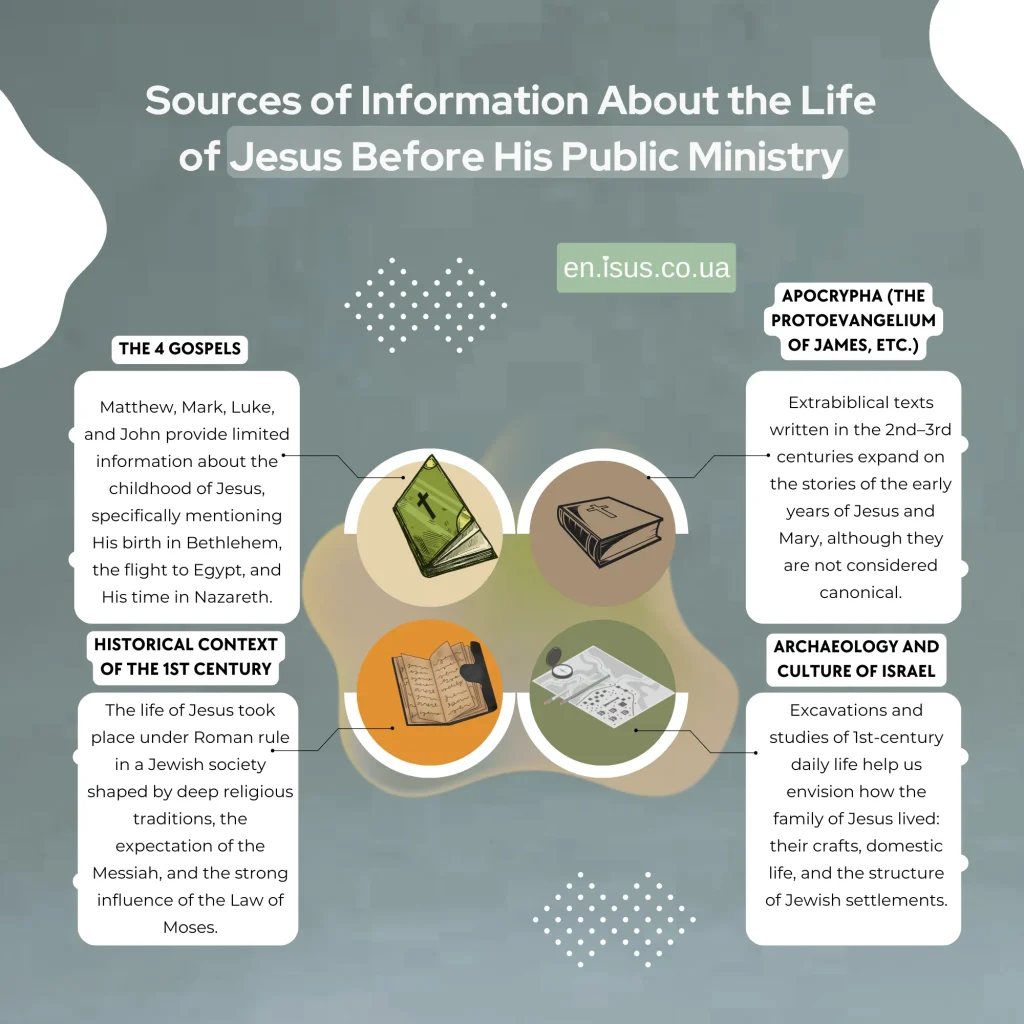
| Джерело | What It Reveals to Us |
|---|---|
| Євангелія від Матвія і Луки | Description of the birth, flight to Egypt, life in Nazareth |
| Євангеліє від Луки 2:41-52 | The only mention of teenage Jesus in the Temple |
| Історико-культурні дослідження | Daily life in Nazareth, Jewish education, traditions |
| Апокрифічні джерела | Assumptions without canonical status |
| Туринська плащаниця | Scientific data on Jesus’ appearance and blood |
With respect for the facts and faith in the truth, it is worth studying the entire life of Jesus – from His holy childhood and the labor of a craftsman to His silent prayers and public words.
All of this is golden seed for the heart ❤️.
His path is an example not only for priests or theologians, but for you, who seek love, peace, meaning, and true joy.
The Early Years of Jesus: From Birth 👩🍼 to Coming of Age 🧒
Birth and Early Years
Birth in Bethlehem
Jesus Christ was born in Bethlehem of Judea in humble conditions, in a stable 🐑, because there was no room for His family in the inn.
Mary wrapped the Infant and laid Him in a manger.
This simple moment marked the beginning of great hope for all humanity.
The birth of Jesus was accompanied by extraordinary events that stirred both lowly shepherds and powerful wise men from the East.
Shepherds and Angels
On the night of His birth, an angel appeared to shepherds in the fields and announced, “Today in the city of David a Savior has been born to you” – and suddenly the heavens lit up with a host of angels singing, “Glory to God in the highest, and on earth peace.”
Wise Men from the East
Wise men (magi) came from the distant East, guided by a star ✨.
They were searching for the newborn King of the Jews and brought Him gifts: gold – as to a king, frankincense – as to God, and myrrh – as to the One who would face death.
Each gift held deep meaning and prophetic significance.
Flight to Egypt
After the birth of Jesus, King Herod, having learned about the birth of a new King, sought to kill Him.
An angel of the Lord warned Joseph in a dream, and the holy family – Mary, Joseph, and Jesus – fled to Egypt.
Thus, the Child was preserved from deadly danger.
This episode reveals how real the trials in Christ’s life were even from His earliest days.
Return to Nazareth
After Herod’s death, the angel appeared to Joseph again and told him it was time to return.
The family settled in Nazareth, a small Galilean town, which became Jesus’s home for many years.
Fulfillment of Prophecies in the Childhood of Jesus
Every event in His early life had been foretold by the prophets:
- Place of birth – Bethlehem (Micah 5:2)
- Calling from Egypt: “Out of Egypt I called My Son” (Hosea 11:1)
- Rejection in Nazareth: “He will be called a Nazarene” – a symbol of humility and obscurity
These facts are not just a chronology of events, but confirmation of God’s plan and the continuity of the saving promise.
Tips for Deeper Understanding
- Read the Gospels of Matthew chapters 1-2 and Luke chapters 1-2 – these contain the most complete account of Jesus’s childhood
- Pay attention to names, geography, and the symbolism of the gifts 🎁
- Reflect on how God chooses the simplest setting to reveal His greatest glory
Insights
- The birth of Jesus was not a loud event for earthly kings, but a joy for heaven and simple hearts
- Shepherds were the first to hear the Good News – God seeks the sincere, not the important
- God’s will may lead to another country, even Egypt, to preserve life and prepare for the future
Table: Key Events in the Early Childhood of Jesus
Here is a two-column table with the major events from Jesus Christ’s early childhood:
| Event | Place, Symbolism, Prophecy/Source |
|---|---|
| Birth | Bethlehem. The coming of the Messiah in simplicity. Prophecy: Micah 5:2 |
| Worship by the shepherds | Fields of Bethlehem. First recognition by ordinary people. Source: Luke 2:8-20 |
| Worship by the Magi | House in Bethlehem. Recognition by the nations, the Gentiles. Source: Matthew 2:1-12 |
| Flight to Egypt | Egypt. God’s protection, echo of Moses’ journey. Prophecy: Hosea 11:1 |
| Return to Nazareth | Nazareth. Beginning of Jesus’ hidden life within the family. Source: Matthew 2:23 |
These events are not just history – they are a path of love.
God entered our world as a baby so that anyone could receive Him without fear.
His childhood was a tender response from Heaven to the need of the earth.
Life in Nazareth
The Socioeconomic Status of Jesus’s Family
The Holy Family lived in a simple village 🌾 among ordinary people.
Joseph was a carpenter – a craftsman who worked not only with wood 🪵, but also with stone 🪨 and metal.
Scripture uses the word “tekton,” meaning builder.
This indicates that the family was not wealthy but had a stable source of income.
Jesus grew up in labor.
He knew what physical fatigue felt like, how to handle materials, how to help His father in his trade.
That’s why in His parables He describes the work of farmers, fishermen, landowners, and builders so deeply and accurately.
His knowledge was not theoretical – it was wisdom rooted in lived experience.
You can be sure: the Son of God, who created the universe, did not disdain the hammer 🔨 and the axe 🪓.
He sanctified daily work, showing that it is a path to maturity, humility, and service.
This is an important example for you: even ordinary work, when done with love, can become a prayer 🙏 if God is in your heart.
His Family: Mary, Joseph, Brothers and Sisters (Interpretation)
Mary – His Mother – a woman of purity, humility, strength, and faith.
She raised Jesus with tenderness and a deep awareness of His great mission.
Joseph – God’s chosen one – never spoke a word in the Gospels, but his faithfulness, labor, and silent love speak volumes.
His presence was the foundation of safety for the young Jesus.
The Gospels mention Jesus’s brothers and sisters – James, Joseph, Simon, and Judas.
In the Hebrew language of that time, the word “brothers” could also mean cousins or close relatives.
In Christian tradition, it is accepted to believe in the perpetual virginity of Mary.
Therefore, the Church interprets these mentions as relatives, not biological siblings.
This also shows that Jesus grew up in a large extended family.
He knew how to interact with other children, help elders, live among loved ones – and remain obedient, sincere, and kind.
His example is an inspiration for families today: to live simply, but with love ❤️.
What Was Nazareth in the First Century: Village 🌾, Daily Life, Traditions
Nazareth in Jesus’s time was a small settlement with a population of about 300-500 people.
It is not mentioned in the Old Testament – so modest and insignificant it was at the time.
According to archaeological research, Nazareth had simple mudbrick and stone houses, ovens, small vineyards, and olive groves.
People lived in families, with households combining both farming and crafts.
A typical home had one or two rooms, with windows high up or none at all, and a roof used as a terrace.
Cooking was done over an open fire; meals included bread, fish, fruits, vegetables, and meat on festive occasions.
Water came from the public well 💧; daily work took place in the field 🌻, workshop, or at home.
Customs in Nazareth were deeply rooted in Jewish tradition:
- weekly synagogue attendance on the Sabbath
- reading of the Torah
- festivals like Passover, Tabernacles, and Purification
- strong emphasis on family ties and paternal authority
- honoring God through daily living: morning and evening prayers 🙏, observance of kosher rules, and purity laws
Jesus lived in this rhythm.
He knew how to weave baskets, how to celebrate Passover, how to listen to the Holy Scriptures in the synagogue.
He was part of His community.
His human nature is not an abstraction.
It was full and real: He knew labor, pain, fatigue, waiting, and the joy of simple things.
This experience made Him not a distant God but a Close One who understands you to the depth of your heart.
His life in Nazareth is a living lesson on how to be kind, loving, obedient, patient, humble, and holy in everyday life.
You can live this way too.
And this is the path to true joy 😊.
The Teenage and Youth Years of Jesus
The Gospel Account of the 12-Year-Old Jesus in the Temple
The Symbolic Meaning of This Story
The event described in the Gospel of Luke (2:41-52) is the only recorded mention of Jesus’ childhood after His birth.
It is not merely a historical fact, but a profound spiritual message for all generations.
Jesus is twelve years old.
This is the age when a Jewish boy approaches adulthood, when he begins to read the Torah independently, participates in synagogue life, and prepares for a deeper understanding of the Law.
At this very time, Jesus comes to the temple in Jerusalem – not only as the son of Mary and Joseph, but as the Son of God, openly revealing His true calling for the first time.
This Gospel passage gives us several clear and important facts:
- Jesus stays in the temple after Passover without informing His parents and spends three days there engaging with the teachers
- He does not simply listen but asks questions and gives answers, astonishing the wise scribes
- When Mary and Joseph find Him, He says, “Did you not know that I must be about My Father’s business?”
This story reveals several key truths:
- Jesus’ Self-Awareness as the Son of God
At the age of twelve, Jesus already clearly understands His divine origin.
He does not say “in my father’s house,” but rather “about My Father’s business,” pointing to the temple as the place to which He truly belongs.
- Spiritual Maturity at an Early Age
Jesus is not playing in the temple.
He chooses to engage with teachers, to discuss deep topics, to reflect on God’s Word.
This is an example of wisdom 📚 far beyond His years.
- A Model for Teenagers and Parents
Jesus shows that adolescence is not a time for rebellion, but a season of deep searching, listening, and discovering one’s identity in God.
He listens, but also asks questions – with respect and understanding.
His dialogue is a model for what spiritual growth 📈 should look like.
- Tension Between Family and Heavenly 🌤️ Calling
Mary and Joseph do not immediately understand that Jesus is already stepping beyond the boundaries of ordinary childhood.
They search for Him as their Son but find Him already as a Teacher.
He returns with them to Nazareth, remaining obedient, yet inwardly He fully belongs to the Heavenly Father.
- The Discovery of the Temple’s Meaning
For Jesus, the temple is not just a place of rituals.
It is a space of God’s presence, a place of service, a place of conversation with the Father.
This is a key 🗝️ to understanding His future mission.
In conclusion, this event is a powerful example for everyone:
- For children – how to seek God with the heart
- For teenagers – how to combine obedience to parents with faithfulness to one’s calling
- For parents – how to trust their children, even when they grow faster than expected
- For all – how to desire God’s wisdom every day
It is important to remember: Jesus did not become the Messiah at age thirty – His path began in childhood.
And every child, every teenager, just like each of us, can already live with God – sincerely, deeply, and in the light.
His Upbringing and Education
Education Among Jewish Boys of That Time
In Jewish families of the first century, educating children was considered a sacred duty.
Every father was responsible not only for teaching his son a trade but also for passing on the knowledge of God.
Boys began studying the Holy Scriptures at the age of five.
The primary text was the Torah – the first five books of Moses.
Until the age of six or seven, education took place at home under the guidance of the father.
After that, children were sent to the synagogue school in their local community.
In this school, they learned writing 📝, reading 📖, memorization of the Scriptures, and the basics of the Law.
Discipline was strict.
The main teaching method was constant repetition of the text.
The goal was not just to know the words but to understand their meaning and to live according to them.
Studying the Torah shaped a child’s character, obedience, attention to detail, and the ability to think in moral categories.
Studying the Torah, Manual Work, Family Duties
Jesus grew up in a deeply faithful 🙏🤍 family 🧑🧑🧒🧒.
His education was not limited to formal schooling.
Much of His knowledge came through daily life.
He saw how Joseph prayed, worked, and interacted with others.
Jesus absorbed all of this as normal – not through words, but by example.
Work was considered sacred.
From an early age, children participated in household tasks 🐣🐴🦆.
Jesus fulfilled His duties with sincerity and obedience.
He carried water 💧, helped His mother, swept the floor, and brought wooden boards to the workshop.
At the same time, He studied the Scriptures – aloud, syllable by syllable, with reverence for every letter.
His ears were tuned to truth.
His heart 🤍 – to kindness 👍.
Family life shaped in Him patience, attentiveness to others, and the ability to rejoice in simple things.
This kind of upbringing became a strong foundation for His future mission.
He May Have Learned His Father’s Trade – Carpentry
Joseph was a carpenter – a tekton.
This wasn’t limited to working with wood.
In Galilee at that time, a carpenter could also work with stone, clay, and metal.
He was a builder, a handyman skilled in many trades.
As the eldest son, Jesus most likely learned this craft from a young age.
It was a form of respect for the father – part of being raised in the spirit of humility.
Manual labor cultivated endurance, precision, and honesty.
His craft connected Him with ordinary people – clients, neighbors, apprentices.
Jesus knew the value of labor.
He knew exhaustion, calloused hands, and the early morning chill 🧊 in the workshop.
This did not diminish His divinity – it brought Him closer to each of us.
His parables would later be filled with imagery from the life of a craftsman: a house built on rock, an axe laid to the root, a yoke that is easy to bear, salt that loses its flavor.
His knowledge came not from books, but from life – not just through the mind, but lived through the heart.
Summary table: The elements of Jesus’ upbringing
| Jesus’ Abilities | Manifestation in the Gospel and Life |
|---|---|
| To heal | Restored the health of the blind, deaf, paralyzed, and lepers |
| To raise the dead | Brought Lazarus, the widow’s son in Nain, and Jairus’s daughter back to life |
| To show compassion | Wept over Jerusalem, showed mercy to sinners, supported the oppressed |
| To teach with wisdom | Sermons, the Sermon on the Mount, and parables – simple yet profound |
| To cast out evil spirits | Freed people from spiritual bondage (the legion, the possessed boy) |
| To command nature | Calmed the storm, walked on water, multiplied loaves |
| To build deep relationships | With disciples, Mary and Martha, the community, love for people |
| To be humble | Obedient to Joseph and Mary, humble before the Father, accepted the cross |
| To forgive | Forgave even on the cross: “Father, forgive them, for they know not what they do” |
| To live simply | Worked as a carpenter, had no wealth, traveled on foot, lived like an ordinary person |
| To explain complex things simply | Parables of the seed, the prodigal son, the good Samaritan |
| To sense the human heart | Saw faith, pain, doubts, and thoughts – as with Nathanael or the Samaritan woman at the well |
| To be a good mentor | Taught the apostles, strengthened their faith, inspired their mission |
| To live in prayer | Prayed alone, at night, before important events |
| To be courageous | Faced challenges, stood before crowds, did not betray the truth even on the cross |
Jesus did not rush to begin His public ministry.
He grew.
He learned.
He worked.
He loved.
He was silent.
And that silence was full of meaning.
You too can find in His example a response for your present moment: grow in love, live in obedience, seek the truth not in haste, but in a deep and quiet heart.
The Profession of Jesus: Who He Was Before the Ministry Began
“Carpenter” – what does it mean? Truths even from the cross
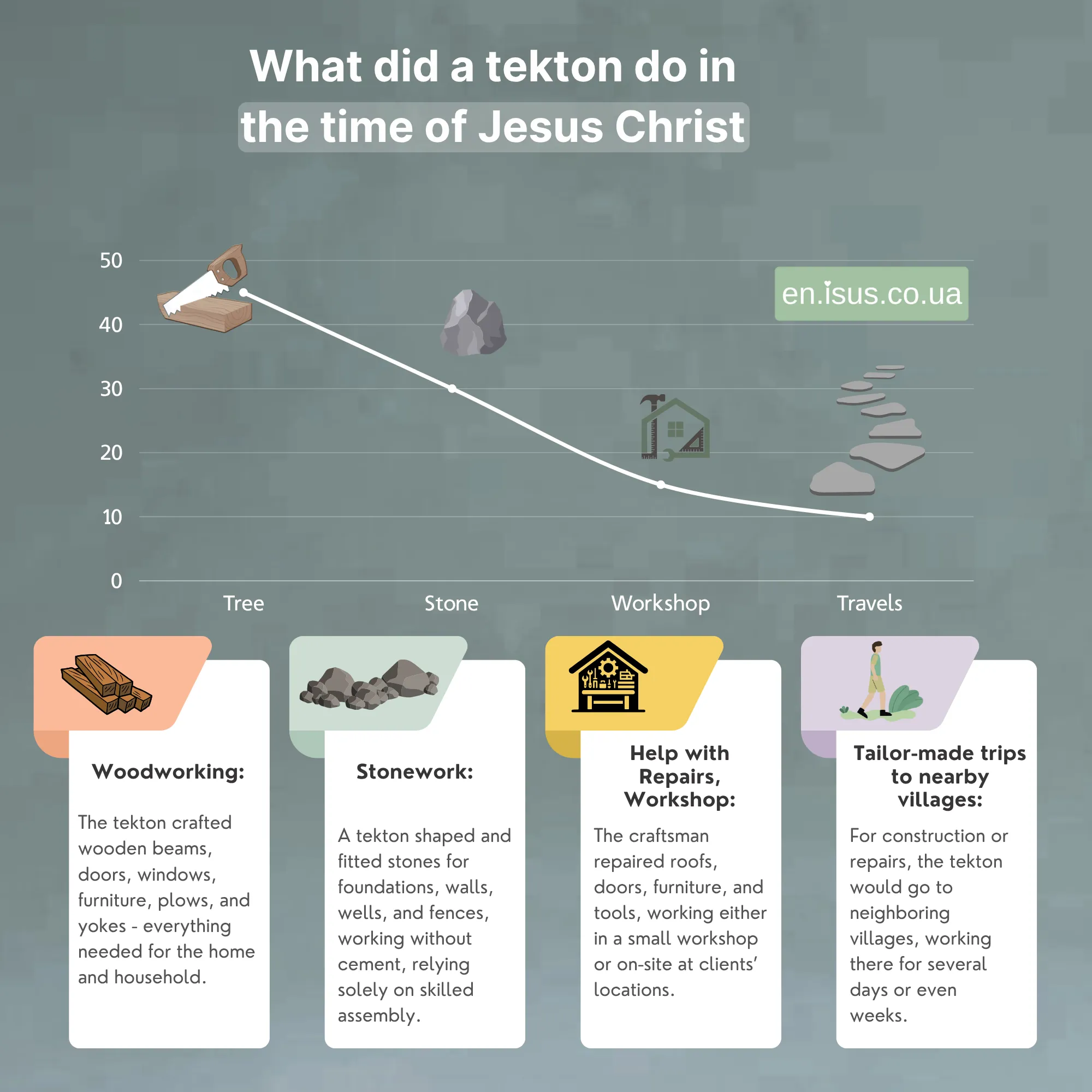
In the Gospel of Mark (6:3), Jesus is called a “carpenter”, and the Greek word used in the original is “τέκτων” (tekton).
This word does not refer only to a carpenter as we commonly imagine – a person working with wood – but more broadly to a skilled craftsman or builder, someone proficient in working with wood, stone, and often even metal.
In first-century Palestine, such labor was incredibly important.
It was a world without factories or machinery, where everything was made by hand.
A tekton could:
- make agricultural tools: plows, yokes, shovels, hoes
- build roofs, doors, windows, benches, fences
- repair boats and carts
- construct simple structures or assist in stone buildings
- work on commission for local residents, markets, and households
This was physically demanding and responsible work, requiring knowledge, precision, patience, and strength.
Jesus worked with His hands 🙌.
He lived in a world of simple daily labor and understood its value. It’s no coincidence that in His parables He often mentions landowners, builders, craftsmen, vine-growers 🍇, and fishermen 🎣.
Work as preparation for mission
Jesus spent about 18 years doing such work – from the time He was a teenager until the beginning of His public ministry at the age of 30.
This was a period of deep maturation, learning, and rooting Himself in the reality of human life.
Jesus’ work:
- taught Him patience and attention to detail
- instilled an understanding of human need, poverty, and injustice
- strengthened Him physically, since the mission awaiting Him would be exhausting
- brought Him close to ordinary people – those whom He would later call His friends
For you, this example is not just a historical fact.
It is an inspiration.
No labor is in vain when it is done with love, honesty, and faithfulness.
Jesus showed us: service to God begins not only in the temple, but also in the workshop, in the field, and at home.
Table: What a Tecton Did in the Time of Jesus
| Type of Activity | Material / Result |
|---|---|
| Manufacturing of agricultural tools | Wood, metal / Plow, yoke, hoe |
| Construction of household elements | Wood, stone / Doors, windows, benches, tables |
| Repairing boats and carts | Wood, iron / Transportation for daily life |
| Assistance in construction | Stone, clay / Housing, utility buildings |
| Work on request | All of the above / Response to specific human needs |
The Life of Jesus as a Carpenter – Good News for All Who Work with Their Hands.
He was with you even before you heard about Him.
He knows what it’s like to be tired, to work hard, to hear gratitude – or silence – in return.
His love begins with the fact that He walked this path with humanity – not from a throne, but from a workshop 🔨.
The Meaning of Jesus’ Work for His Future Ministry
Jesus Christ lived an ordinary life as a simple Jewish man before beginning His public ministry.
He worked with His hands.
That’s why His words were understood by everyone.
Work wasn’t foreign to Him – on the contrary, it became the foundation of His teachings and examples through which He revealed the depths of the Kingdom of God.
The way Jesus labored influenced not only His ability to speak to people’s hearts 🩵🤍 but to be truly present with them – with love.
How Jesus Learned to Understand Common People
- He knew the cost of hard, daily labor
- He saw the fatigue and hopes of rural families
- He understood the life of a craftsman, a farmer, a fisherman
- He did not teach from above – He spoke as one of them
- His words were not complicated theories but responses to real human needs
It wasn’t just compassion – it was deep unity with the people.
Jesus did not come into a palace, but into the home of a carpenter.
He was not born among the rich, but among those who work every day.
Work as the Language of Parables
Jesus taught through parables – short life-based stories that everyone could understand.
Most of them are built around images of labor, land, and craftsmanship.
He did not choose complex philosophy but focused on simple, familiar things that everyone had seen and understood.
Table: Work in the Parables of Jesus
| Parable | Type of Work / Teaching |
|---|---|
| About the Wise Builder | Building a house on the rock – the wisdom of hearing the Word and putting it into practice |
| About the Sower | Agriculture – different hearts, different responses to God’s Word |
| About the Vineyard Workers | Vineyard cultivation – faithfulness, labor, submission to God |
| About the Talents | Resource management – the importance of multiplying gifts and not hiding them |
| About the Workers in the Vineyard | Hired labor – God’s mercy and justice |
These examples not only reveal the essence of the Kingdom of God, but also elevate work itself – as a path of service, growth, and faithfulness.
Practical insights for daily life
- If you work with your hands – you are like Jesus, who held tools and knew the feeling of exhaustion
- If you teach children – teach through life examples, just as Jesus did
- If you lead others – lead with understanding and care, like a true Good Shepherd
- If you want to be closer to people – be with them in the simple, everyday things, in shared work
Conclusion
Jesus Christ showed that ordinary work has eternal significance.
Through it, one can learn wisdom, patience, and love.
And if you are weary, remember – Jesus was a carpenter.
He knows what it’s like when your hands ache.
But it was through that work that He learned to speak to every heart.
And that is why His words are alive even today.
The hidden years: what did Jesus do before the age of 30?
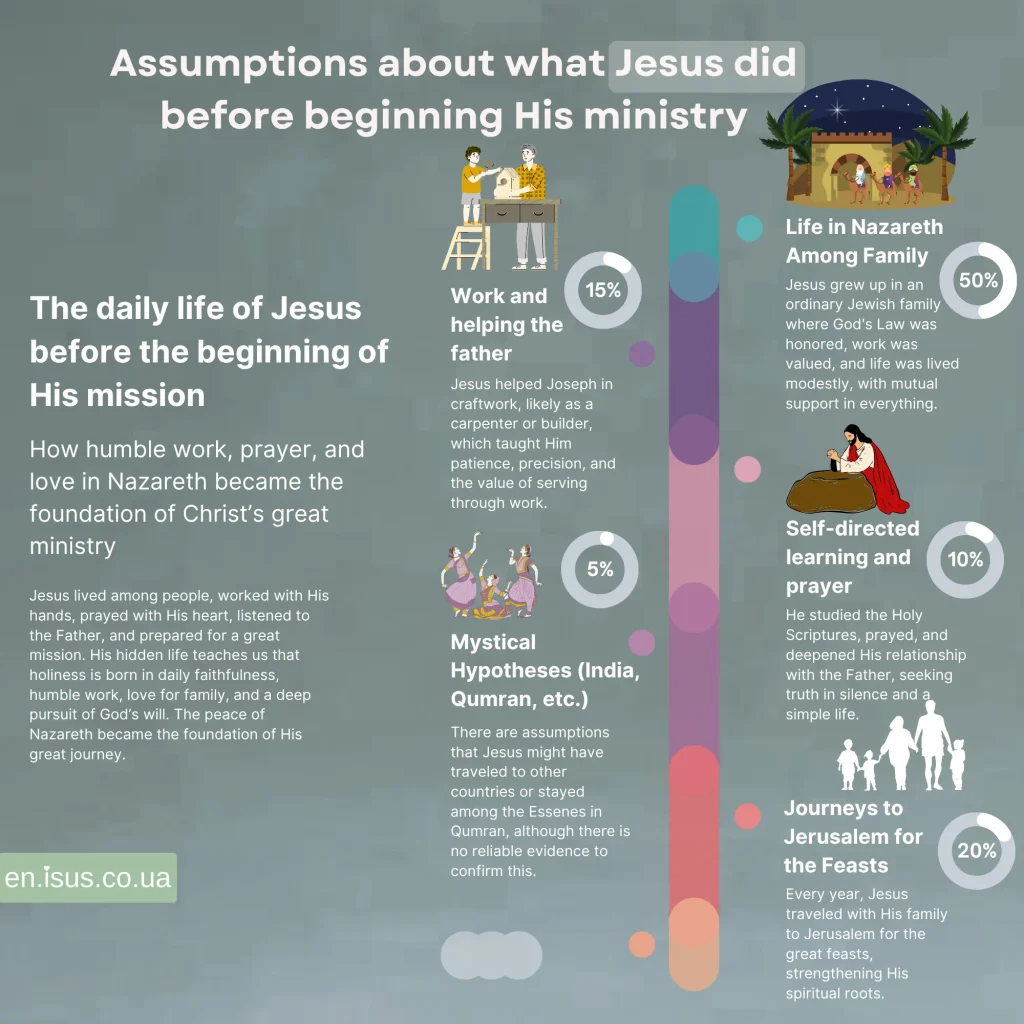
The Gospels contain almost no information about the period of Jesus Christ’s life between the ages of 12 and 30.
This is the longest and least described stage of His earthly life.
Yet these years were a crucial time for the formation of His human personality, maturity, prayer, work, and daily communion with the Father.
Below are key 🗝️ hypotheses and facts that help to better understand this period.
Assumptions and hypotheses
1. Why the Gospels are silent about this period
- The evangelists focused on what was essential – the saving mission of Christ, which began with His baptism at the age of 30.
- Jesus lived in humility, simplicity, in an ordinary environment. He did not seek fame, which is why His life before public ministry was not widely described.
- The silence of the Gospels is a silence that teaches. It highlights the value of hiddenness, inner growth, and spiritual maturity.
2. The most well-known hypotheses
| Hypothesis | Brief Description / Evidence / Counterarguments |
|---|---|
| Life in Nazareth | Description: Jesus remained in His family home, worked as a carpenter, studied, and prayed. Evidence: Luke 2:51-52: “Jesus grew in wisdom and stature, and in favor with God and man.” Counterarguments: Lack of detailed information about His daily life. |
| Journey to Egypt | Description: Some believe Jesus may have returned there after His childhood escape, possibly for learning. Evidence: Egypt was a spiritual center; Jesus had already been there. Counterarguments: The Bible only mentions His childhood stay. |
| Qumran and the Essenes | Description: The theory suggests Jesus may have studied with the Essenes – a community near the Dead Sea. Evidence: Similar themes of repentance, ritual washing, fasting. Counterarguments: Jesus did not share the Essenes’ ascetic isolation. |
| Journey to India | Description: A legend claims Jesus traveled to India to learn wisdom. Evidence: Some apocryphal texts and Indian legends. Counterarguments: No historical proof; complete silence in the Gospels. |
3. Analysis of Arguments “For” and “Against”
Arguments in favor of possible travels:
- A desire to explain Jesus’ profound wisdom through foreign influences
- The resemblance of some of His moral teachings to Eastern philosophy
- The preservation of apocryphal stories and legends in other cultures
Arguments against:
- Jesus’ deliberate obedience to tradition, His presence in His family until the beginning of His ministry
- The Sermon on the Mount has deep Jewish roots, not borrowed from outside sources
- The words of the people of Nazareth: “Isn’t this the carpenter, the son of Mary?” indicate they knew Him well and that He had not left the village for long
Conclusion
The hidden years of Jesus were not lost but blessed.
He lived in silence, in labor, in love ❤️ for people.
It was a time of inner maturity, of rooting Himself in human life.
Jesus did not come from a distant school, but from a simple family, from little Nazareth – and in this, He sanctified the ordinary life of each of us.
His silence speaks louder than many words.
A time of inner growth 📈
Jesus lived most of His earthly life not on great stages, but in quietness.
It was this silence, simplicity, and hiddenness that became the soil for His great Mission.
Until the age of 30, He did not preach in public squares or perform miracles.
He lived among people, worked, listened 👂, prayed 🙏, and loved ❤️.
His life was ordinary on the outside but filled with depth, obedience, and strength within.
Prayer: the source of inner light
Jesus was the Son of God, yet He did not neglect prayer.
He prayed as a Man who loves the Father.
In Nazareth, His prayer was not theatrical.
It was sincere, simple, and filled with love.
Prayer is not only words.
It is presence.
Jesus learned to dwell in the presence of God.
He spoke with the Father in silence – in the morning when He awoke, while working with His hands, when He saw others’ pain, when He fell asleep under the stars.
For Him, it was not a routine – it was the home of His soul.
Contemplation: seeing deeper
In every piece of wood He shaped, in every stone He carried, Jesus saw more than matter.
He looked with the eyes of the heart.
Contemplation is the ability to see the essence, not just the form.
That is why His parables were so vivid: because even before His Ministry, He had learned to see truth in the simple.
To see God in wheat, in a mustard seed 🌾, in water 💧, in bread 🍞 – this became possible through years of contemplation.
Listening to the Father: in the heart, not just the ears
Listening is no less important than speaking.
Jesus was attentive to the voice of the Father in the quietness of daily life.
He did not rush or interrupt.
He listened.
And it was this listening that formed in Him a clear understanding – where to go, what to say, when to remain silent.
That is why His words later carried such power: because they were thoughtful, born from deep within.
Work: ordinary life as preparation
Jesus worked with His hands.
He was likely a carpenter – a tekton.
This Greek term goes beyond woodwork; it covers a wide range of construction crafts.
It is likely that Jesus worked with both stone and wood.
It was hard physical labor.
But that is the beauty of it: He did not avoid daily effort.
He lived among people, understood fatigue, knew the value of a piece of bread 🍞.
He lived honestly, not rushing to glory, because He knew: what is deep is built slowly.
Life among people: holiness in the hidden
Nazareth was not a city of prophets.
It was a modest village 🌿🐥.
Jesus did not choose the capital, nor did He strive to be at the center of attention.
He stayed in the shadows.
His holiness was not outward – it lived in sincerity, in faithfulness, in love for His neighbors.
He was a good Son, a good friend, a good neighbor.
And that too was a testimony
| Lesson from the Life of Jesus | What We Can Do |
|---|---|
| Prayer in silence | Take 5 minutes of silence each day just to be with God |
| Contemplation of the world | Notice the beauty around you – God is in the details |
| Listening | Listen to your heart – not all answers need to be found outside |
| Honest work | Do your work with love, even if no one sees it |
| Presence among people | Be a light in your family, at work, in your neighborhood |
The holiness of Jesus before His baptism was quiet, yet powerful.
He did not rush.
He did not chase success.
He grew – in love, wisdom, and listening.
And this growth became the foundation of what would change the world.
You can grow like this too – daily, step by step.
Do not fear the silence.
God dwells in it 🤍.
The Beginning of Public Ministry
The Baptism of Jesus by John the Baptist
The baptism of Jesus Christ is not just an event marking the beginning of His public ministry.
It is a profound act of humility, love for the Father, and a sign of His readiness to fulfill God’s will to the end.
Jesus came to John not because He needed cleansing.
He was without sin.
But He did it to be close to people – to those who sincerely seek truth, forgiveness, and new life.
He united Himself with everyone who longs for purity of heart 🤍.
The baptism took place in the Jordan River.
It was a place where the Jews came, confessing their sins – as the beginning of inner renewal.
Jesus stood among them, not above them, but at the same level, with tenderness and dignity.
It was deeply human and at the same time divine.
The Symbolism of the Dove 🕊️ and the Voice from Heaven 🌤️
Something extraordinary happened after the baptism.
Jesus came out of the water, and the heavens opened.
The Holy Spirit descended upon Him in the form of a dove.
In biblical tradition, the dove 🕊️ is a symbol of peace, purity, and God’s presence.
It recalls the dove that brought Noah the olive branch – a sign of new life after the flood.
Likewise here: a new story of salvation begins.
And a voice from heaven said, “This is My beloved Son, in whom I am well pleased.”
This is a confirmation of Jesus’ mission from the mouth of the Father Himself.
It is a blessing, an affirmation, a declaration of love.
God openly testified: Jesus is His Son, His messenger, the One who will bring true light into the darkness of the world.
The Beginning of a New Stage
After His baptism, Jesus does not go into the city.
He goes into the wilderness – into silence, into solitude.
There He spends 40 days in fasting and prayer.
It is a time of deep inner focus, a preparation for what lies ahead.
After the wilderness, Jesus returns with the power of the Spirit.
His words begin to touch hearts.
His hands heal.
His eyes look with love 😍.
Thus begins His public mission – a ministry that will change the world and the lives of all who encounter Him.
Baptism is not just an event from the past.
It is an example for each of us.
It reminds us that every new beginning requires determination, prayer, and humility.
And that even the holiest works begin with a quiet, sincere agreement of the heart to God’s will.
If you are seeking peace – turn to the One who became the example of obedience.
If you want to start again – remember that Jesus began His mission with a simple but great step—baptism.
With love for God and for you.
The Temptation in the Wilderness


40 Days of Fasting
After His baptism in the Jordan River 🏞️, Jesus Christ immediately went into the wilderness.
There, He remained alone for 40 days.
This number is not accidental.
In the Bible, it carries deep symbolic meaning: Moses spent 40 days on Mount Sinai, the people of Israel wandered the desert for 40 years, and the flood during Noah’s time lasted 40 days.
All these events marked times of purification, testing, rethinking, and transformation.
Jesus fasted.
He neither ate nor drank, He prayed, and He fully entrusted Himself to the Father.
His fast was not just about abstaining from food.
It was a deep inner journey.
It was a silence for the heart, to hear God.
Fasting is a way to focus not on the physical, but on the spiritual.
Jesus did not choose power, glory, or comfort.
He chose love, humility, and truth.
The Symbolism of Numbers and Temptations
The three temptations that came to Jesus were not just separate trials.
They represent the three main traps the devil sets before every person:
- “Turn stones into bread” – the temptation of the flesh, focusing only on physical needs, living for food, comfort, consumption
- “Throw Yourself down from the temple” – the temptation of fame, pride, the desire to impress, to be at the center of attention, to use God for self-elevation
- “Worship me – and you will receive everything” – the temptation of power, control, and compromising with evil for the sake of results
Jesus answers all three temptations with words from Scripture.
His strength lies in the Word of God, in the truth that lives in the heart.
He does not argue, prove, or fear.
He simply speaks the truth – and the truth triumphs.
Victory Over Satan as Spiritual Preparation
This event in the wilderness is deeply significant.
Jesus did not just endure.
He showed the way.
He experienced what each of us goes through.
Temptations, doubts, weariness, searching.
But He passed through all of it with a pure heart, in full trust in the Father.
His victory was not a demonstration of power, but an example of obedience.
And that is what made it powerful.
It was a spiritual victory of love over evil.
And it became the preparation for His entire public ministry: to help, to heal, to teach, to serve, to give Himself.
Practical Insights for You
- If you are facing temptations – it does not mean you are bad. On the contrary, it may be part of your growth
- Trials purify when you choose truth, even when it’s hard
- Prayer, silence, and fasting are not an escape from the world, but a way to prepare yourself for real life
- The Word of God is not just a book. It is a source of strength for everyday choices
May this story of Jesus in the desert 🏜️ be an inspiration for you.
| Temptation Scenario | Meaning and Lesson |
|---|---|
| Bread from stones | Essence: living only by the flesh, satisfying only physical needs Jesus’ reply: “Man shall not live by bread alone” Lesson: Do not live only by your needs – nurture your soul deeply. |
| Jumping from the temple | Essence: temptation of fame, desire to impress others Jesus’ reply: “Do not test the Lord your God” Lesson: Do not seek recognition – seek truth. |
| Worshiping the devil | Essence: compromise for the sake of power, quick success at the cost of faith Jesus’ reply: “Worship the Lord your God, and serve Him only” Lesson: Do not trade your soul for temporary gain. |
He was human, just like you.
And He overcame.
Which means – you can too.
Not by your own strength, but by the love that never fails.
What did Jesus do during His public ministry?
Jesus Christ began His public ministry after being baptized in the Jordan and fasting for forty days in the wilderness.
He was about 30 years old.
Everything He did was in perfect harmony with the will of the Father.
His ministry was filled with love, care, clear ☀️ words, healing, and hope for everyone seeking truth.
Preaching the Kingdom of God
Jesus did not build theories, gather followers for political power, or establish schools of philosophy.
His goal was to reveal the Kingdom of God as a reality that begins here and now.
He spoke simply and clearly, using everyday examples – but the depth of His words was as vast as eternity.
The core theme of His teaching
The Kingdom of God is the central theme that runs through all of Jesus’ sermons.
It is not just a place, but a condition of the heart where God reigns.
It means justice, peace, mercy, forgiveness, purity, and love for one’s neighbor.
Key messages of His teaching:
- God is our loving Father
- The Kingdom of God is open to anyone who believes
- The sinner can be forgiven
- Love is more important than ritual
- A person is more valuable than the law
The Sermon on the Mount 🗻 – an ethical revolution
The Sermon on the Mount (Gospel of Matthew, chapters 5-7) is the most well-known speech of Jesus, radically transforming the concept of true holiness.
It includes the Beatitudes, principles of relationships, attitude toward enemies, sincerity in prayer, fasting, service, and trust in God.
Main points of the Sermon on the Mount:
| Topic | Jesus’ Position |
|---|---|
| Beatitudes | Happiness is not in power, but in humility and purity of heart |
| The Law | Not its abolition, but its fulfillment through love |
| Anger | Even the intention is condemned |
| Marriage | Marriage is sacred, and faithfulness is a principle |
| Prayer | Secret, sincere, with the “Our Father” as a model |
| Faith | Trust in the Father even in the smallest things |
| Neighbor | Love even your enemies |
These are not just moral rules.
This is the lifestyle of the Kingdom, which brings happiness already now and prepares a person for eternity.
Parables – teaching through images
Jesus spoke in parables – short stories with deep spiritual meaning.
In parables, He explained complex things through familiar images: a seed, a sower, sheep, a vineyard, a lamp, a treasure.
Through them, He addressed both the mind and the heart.
Examples of well-known parables:
| Title | Teaching |
|---|---|
| Parable of the Sower | God sows His word into human hearts, but not everyone accepts it |
| Parable of the Prodigal Son | God’s love is greater than guilt |
| Parable of the Good Samaritan | Mercy is greater than religious formality |
| Parable of the Lost Sheep | God seeks everyone who is lost |
| Parable of the Ten Virgins | Be ready to meet Christ |
These parables are alive because they touch the deepest human desires – to be accepted, forgiven, heard, and loved.
They leave a light in the heart and an invitation to transformation.
Jesus did not simply teach.
He lived what He taught.
There was no gap between His words and His actions.
His preaching was not a lecture but a living example.
That is why people believed Him.
He didn’t impose – He inspired.
He didn’t condemn – He supported.
He didn’t seek greatness – He chose simplicity.
And His love remains unchanged for each of you.
Miracles and Healings
Jesus Christ performed miracles out of love for people.
His actions were not for show or fame.
He didn’t just help – He touched hearts, restored dignity, brought life back, and filled souls with hope.
His miracles were always a response to pain, suffering, or faith.
Categories of Miracles Performed by Jesus:
Physical Miracles
These include healing bodily diseases, deformities, and congenital or acquired ailments.
Jesus would touch people – and they would be healed. Examples:
- Healing of the man born blind (John 9:1-7)
- Healing of the paralyzed man at Bethesda (John 5:1-9)
- Cleansing of the ten lepers (Luke 17:11-19)
Spiritual Miracles
These are acts of deliverance from demonic possession, restoration of inner peace, and forgiveness of sins. Examples:
- Casting out demons in the region of the Gadarenes (Matthew 8:28-34)
- Healing the boy possessed by a mute spirit (Mark 9:14-29)
- Forgiving the sins of the paralytic (Mark 2:1-12)
Supernatural Miracles
These are events that defy the laws of nature.
They reveal His authority over all creation. Examples:
- Calming the storm (Mark 4:35-41)
- Walking on water (Matthew 14:22-33)
- Turning water into wine (John 2:1-11)
- Raising Lazarus from the dead (John 11:1-44)
Why Did Jesus Perform Miracles?
- Out of love for people. Every miracle is a touch of love. He saw the need and responded immediately
- To reveal God’s mercy. God is near. He does not remain silent when there is pain
- To strengthen faith. A miracle always speaks to the heart and lifts it higher
- To confirm His divine mission. The miracles testified that He was not merely a Teacher, but the Son of God
- To teach compassion. Jesus showed how to act – to see, to listen, to serve
Key Examples of Jesus’ Miracles
Here is a two-column table format:
| Event | Description of the Miracle |
|---|---|
| Healing of the man born blind | Type: Physical Essence: A person who had never seen before in his life gains sight Reference: John 9:1-7 |
| Raising of Lazarus | Type: Supernatural Essence: A man who had been dead for four days comes out of the tomb alive Reference: John 11:1-44 |
| Calming of the storm | Type: Supernatural Essence: A deadly storm threatening the disciples is suddenly calmed Reference: Mark 4:35-41 |
Practical insights for you:
- A miracle doesn’t have to be spectacular. Sometimes the deepest miracle is peace in the heart where there was none before
- If you long for a miracle, open your heart to faith, just like those who came near to Jesus
- Every day carries His touch – in healing, in light, in unexpected joy, in the simple fact that you are alive
Jesus does not change.
He is the same – yesterday, today, and forever.
His miracles still continue today, in your life.
Believe with the sincerity of a child.
And miracles will no longer be exceptions, but part of your daily reality.
The choosing of the apostles and disciples


Jesus Christ deliberately chose simple, ordinary people to be His closest disciples and apostles.
He did not seek scholars, rulers, or scribes.
He needed those with open hearts – those who could listen, trust, and love.
Jesus saw in fishermen, tax collectors, and zealots the potential to become builders of a new world.
Who were the apostles?
All twelve apostles were very different from one another.
Some of them:
- Peter and Andrew – fishermen 🎣 from Galilee, brothers
- James and John – sons of Zebedee, also fishermen
- Matthew – a former tax collector, despised by many
- Simon the Zealot – a member of the political movement of the zealots
- Thomas – inclined to doubt, yet deeply loyal
- Judas Iscariot – the traitor, whom Jesus also called
These men were ordinary, sometimes flawed, but open to learning and transformation.
They came from different social backgrounds and had diverse personalities, but Jesus united them around truth and love.
Why exactly twelve?
The number 12 holds deep biblical significance.
It symbolizes the fullness of God’s people and recalls the 12 tribes of Israel.
Jesus chose 12 apostles as the new spiritual foundation of God’s Kingdom on earth.
| Number 12 in the Bible | Meaning |
|---|---|
| 12 tribes of Israel | God’s people in the Old Testament |
| 12 apostles | The new people of God in Christ |
| 12 thrones in eternity | Jesus’ promise to the apostles (Matthew 19:28) |
This choice was intentional, prophetic, and symbolic.
Jesus didn’t simply gather a group of people – He was renewing the Covenant between God and humanity through a new spiritual community.
The Community Around Jesus
In addition to the twelve apostles, Jesus was constantly surrounded by a broader group of disciples.
Among them were:
- The seventy disciples He sent out in pairs (Luke 10:1)
- Women who served with love: Mary Magdalene, Martha, Mary the mother of James
- People who believed, listened, and followed Him from towns and villages
This was the first spiritual community – informal, yet powerful.
They shared with Jesus the journey, the bread, the joy, and the tears.
True discipleship is not just about learning – it is a deep connection of hearts ❤️🤍.
Jesus taught them through example, gentle words, prayer, trust, and forgiveness.
What We Can Take for Ourselves
- God chooses not the strongest, but the most open
- Faith is born in simplicity and truth
- Jesus creates community where there is trust, love, and service
- Every person can become His disciple – regardless of education, profession, or past
Jesus did not need perfect people.
He needed the faithful.
And today, He still seeks a heart ready to follow Him – with faithfulness, kindness, and truth.
Prayerful Life and Withdrawal
Jesus and the Wilderness
Jesus Christ regularly withdrew into desert places to pray.
This is a deep example for anyone seeking stillness of heart and a genuine connection with God.
The wilderness for Jesus was not an escape from the world, but a place of strength.
It was there that He prepared for ministry, battled temptations, and listened to the voice of the Father.
He didn’t need loud public prayers – His prayer was sincere, personal, and quiet.
What Does the Wilderness Give?
- Time without distractions
- An opportunity to speak with God – and more importantly, to listen
- Restoration of inner peace
- A test of faith through temptation
When Jesus went into the wilderness for 40 days after His baptism, it wasn’t to run away – it was preparation.
He fasted, prayed, and remained in silence.
The wilderness made Him strong in the face of temptation.
This is a model for each of us: not to run from hardships, but to seek God’s presence in solitude.
Practical Tip: Find “your own wilderness” – a place where no one will disturb you, even for 10 minutes a day.
It could be a bench in the park, a room with the phone turned off 📴, the quiet morning before others wake up.
What matters is being there with God.
Night Prayers
Jesus often prayed at night.
While everyone else was asleep, He would go to the mountain or remain alone.
For example, before choosing the apostles, He spent the entire night in prayer.
This shows how seriously He approached decisions and how deep His connection was with the Father.
Night prayer is an intimate time when nothing distracts.
It is a prayer of trust.
Even when the disciples fell asleep in the Garden of Gethsemane, Jesus continued praying.
He knew: in the darkness of the heart, we need the light of prayer.
Practical Tip: If you can’t fall asleep or wake up in the middle of the night – use that time for a short prayer.
Even one sincere phrase at night is like a gentle breath of the soul toward Heaven.
Examples of Inner Connection with the Father
Jesus constantly emphasized that He did nothing on His own.
He said: “I do nothing of Myself, but only what I see the Father doing.”
His life was a continuous dialogue with God.
He addressed the Father as the Dearest: “Abba” – meaning “Daddy.”
His prayer was not only asking – it was listening, conversing, silence.
It wasn’t a ritual – it was breath.
This is how a heart full of love lives.
Signs of His inner connection with the Father:
- regular withdrawal for the sake of prayer
- complete trust, even in suffering (“Not My will, but Yours be done”)
- love for people that was born from love for the Father
- strength to make hard decisions through unity with Heaven
Practical Inspiration: Pray not only with words, but with silence. Listen with your heart. Sit, like Jesus, in the stillness where you can simply be yourself before the Father. Where you don’t need to explain – just to be.
In prayer, Jesus wasn’t seeking results – He was seeking the Father.
And He always found Him.
You can too.
What Jesus Did in Nazareth
After the Return: Notable Events
Jesus spent most of His earthly life not in Jerusalem or in bustling squares, but in a small Galilean village – Nazareth.
After returning from Egypt, the Holy Family settled there.
It was a humble, inconspicuous place.
Nothing suggested that the One who would later change the course of human history was growing up there.
When Jesus reached adulthood, He, as was customary for every Jew, went to the synagogue.
One day, He was handed the scroll of the prophet Isaiah, and He read the words:
“The Spirit of the Lord is upon Me, because He has anointed Me to preach good news to the poor. He has sent Me to heal the brokenhearted, to proclaim liberty to the captives and recovery of sight to the blind, to set at liberty those who are oppressed, to proclaim the year of the Lord’s favor.”
These words sounded prophetic, solemn, and profound.
But what shocked the listeners most was what He said next: Jesus declared that this Scripture had been fulfilled that very day.
Through this, He revealed Himself as the Messiah.
Yet, His fellow villagers did not accept this revelation.
Rejection by His Own – A Symbolic Meaning
Those who had known Him since childhood saw only “the carpenter’s son.”
Their image of God did not align with the familiar face of a man who had grown up among them.
They could not reconcile simplicity with greatness.
In their hearts – a mix of astonishment, skepticism, and resentment: “Can anything good come out of Nazareth?”
This rejection holds deep spiritual meaning:
- It shows how difficult it is for people to recognize the Divine in the ordinary. Jesus did not arrive with a golden crown; He lived simply, worked with His hands, obeyed His earthly parents
- It reveals the depth of free will: even God’s love can be rejected if the heart is closed
- It teaches humility: Jesus did not defend Himself, argue, or change who He was to be accepted. He remained true and gentle, even in rejection
For you, this may be a tender reminder: do not dismiss the ordinary.
The Divine often dwells in the most familiar things.
God frequently works quietly, invisibly – in the heart, in daily simplicity.
If you sometimes feel misunderstood or rejected – know that Jesus experienced the same.
And that is why His love is so deep.
He is not a distant observer.
He knows the pain of a heart that wants to do good but meets misunderstanding.
He went through it with gentleness and left us an example – not to give up, not to become bitter, but to remain faithful to the Father and respond to indifference with goodness.
Jesus in Nazareth is Jesus beside you.
In daily labor, in silence, within family walls, among simple people.
He comes where He is awaited – even if it’s only the small “village” of your heart ❤️.
Jesus as a Citizen of His Village
Participation in Synagogue Life
Jesus Christ grew up in Nazareth, a small village in Galilee where all men would gather weekly in the synagogue to read Scripture and pray.
He participated in these gatherings from childhood, according to Jewish tradition.
It was not a formality, but a sincere presence – both as a listener and a future Teacher.
He listened to the Torah, Psalms, and the Prophets.
Gradually, He learned to read and interpret the Holy Scriptures.
When Jesus was about thirty years old, He came to the synagogue as any ordinary resident of Nazareth.
He was given the scroll of the prophet Isaiah, and He read the passage: “The Spirit of the Lord is upon Me.”
This moment was pivotal.
The people who had known Him since childhood saw not just a Neighbor, but Someone who spoke with authority.
Yet their reaction was mixed.
Respect for Traditions, but with New Meaning
Jesus did not break good traditions – He observed the Sabbath, went to the temple, celebrated Passover, and taught His disciples to value the Law.
But His life was an example not of mechanical ritual, but of deep understanding of their essence.
He showed that behind every commandment stands love – for God, for neighbor, for life.
His attitude toward traditions was full of reverence, but never fanaticism.
For instance, He healed on the Sabbath, which outraged the Pharisees, but reminded them: “The Sabbath was made for man, not man for the Sabbath.”
He did not destroy, but purified traditions from becoming empty forms without spirit.
His Relatives and Neighbors: How They Saw Him
Jesus grew up among simple people.
He was known as “the carpenter’s son,” “Mary’s son,” “the brother of James, Joseph, Judas, and Simon.”
He lived, worked, ate, built, and spoke with them daily.
To His neighbors, He was “one of them,” until He began His public ministry.
When He returned to Nazareth as a Teacher, the reaction was reserved.
Some marveled at His wisdom; others could not accept His authority.
They said: “Isn’t this the carpenter? Isn’t His mother Mary, and aren’t His brothers and sisters here with us?”
This reaction reflects human limitation – it is difficult to accept a prophet among one’s own.
This is a lesson for everyone: we often underestimate those around us, failing to recognize gifts in familiar faces.
Jesus showed us how important it is to remain a light – even when misunderstood, unaccepted, or rejected.
He lived with love, gentleness, and truth, even among those who doubted Him.
Practical Advice and Insights:
- If you live in a small community where you’re seen as “just an ordinary person,” don’t be afraid to be authentic. God works not through status, but through the heart
- Respect for tradition is not about rigid routine, but thoughtful meaning. Read the Holy Scriptures with an open heart, as Jesus did
- Do not undervalue those close to you – perhaps among them are those whom the Lord has especially called
Jesus in Nazareth is an example of a quiet, simple, yet deeply inspired life.
His rural daily life was sacred, because in every word, every gesture, every deed – there was love.
The Physical Body of Jesus: What Was His Blood Type?
Scientific Research: The Shroud of Turin
The Shroud of Turin is a linen cloth approximately 4.4 meters long and 1.1 meters wide, bearing the image of a man who endured torture and crucifixion.
It is kept in the city of Turin, Italy, and is one of the most extensively studied relics in the world 🌎.
Many Christians believe this is the very cloth that wrapped the body of Jesus Christ after His death on the cross.
From a scientific standpoint, the Shroud draws significant interest.
The image on it is not painted: it contains three-dimensional information and shows no trace of pigment.
It likely formed through a sudden process that science has yet to fully explain.
This is precisely what leads many scholars to regard the Shroud as a unique object at the crossroads of history, physics, and theology.
What the Bloodstains Reveal
The Shroud clearly shows numerous bloodstains – on the forehead, back of the head, hands, feet, and side.
Analyses confirmed it is real human blood 🩸.
It exhibits signs that the person died in extreme physical agony.
This is further supported by the presence of serum around the stains – a phenomenon that occurs only after death.
The most detailed studies have identified the blood type as AB, one of the rarest in the world.
This same blood type was also found on other relics associated with Jesus – for example, the Sudarium of Oviedo in Spain, which, according to tradition, covered His face in the tomb.
This is no coincidence, as both cloths show matching bloodstain patterns and placement.
Blood type AB is interesting in that it only appeared in the human population a few thousand years ago.
It combines characteristics of both A and B types and is universal in the sense that it can receive blood from any group, but can donate only to AB.
Symbolically, the blood of Jesus is open to receiving all, but itself remains unique and unrepeatable.
His entire earthly body was holy, and His blood – precious.
It became the sacrifice of love for each of us.
This scientific data is not a matter of dogma, but it can strengthen trust in the Gospel narrative and inspire deep reverence for the Mystery of the Incarnation: that the Son of God had a true human body, with flesh and blood, and voluntarily embraced suffering for our salvation.
If you are exploring the faith and seeking to understand it not only with your heart but also with your mind 🧠 – these studies can serve as a bridge to deeper knowledge of Christ, His Sacrifice, and His infinite love.
Theological Meaning of the “Unique Blood”
In Christian belief, the blood of Jesus has a saving power.
It was shed for all people, regardless of time, nationality, culture, or background.
As the Epistle to the Hebrews states, His blood “speaks better than the blood of Abel” – it cleanses, renews, unites, and gives eternal life to those who accept Him in faith.
Symbolically, the AB blood type – universal in reception – reflects a profound spiritual truth: Jesus receives everyone.
There are no exceptions in Him.
His love is universal, as is His sacrifice.
If even physically His blood had this characteristic, it only underscores again: He is the Savior of all who come to Him with an open heart.
Practical Summary
AB is a rare blood type, yet universal in receiving.
According to research on the Shroud of Turin, this was the blood type found.
In theology, it symbolizes the fullness of love that accepts everyone.
For believers, it is a reminder that you are always received by Jesus – regardless of who you are, where you’re from, or what your journey has been.
Jesus did not shed His blood in the abstract – but specifically for you.
With love, forever.
General Overview: What Did Jesus Do?
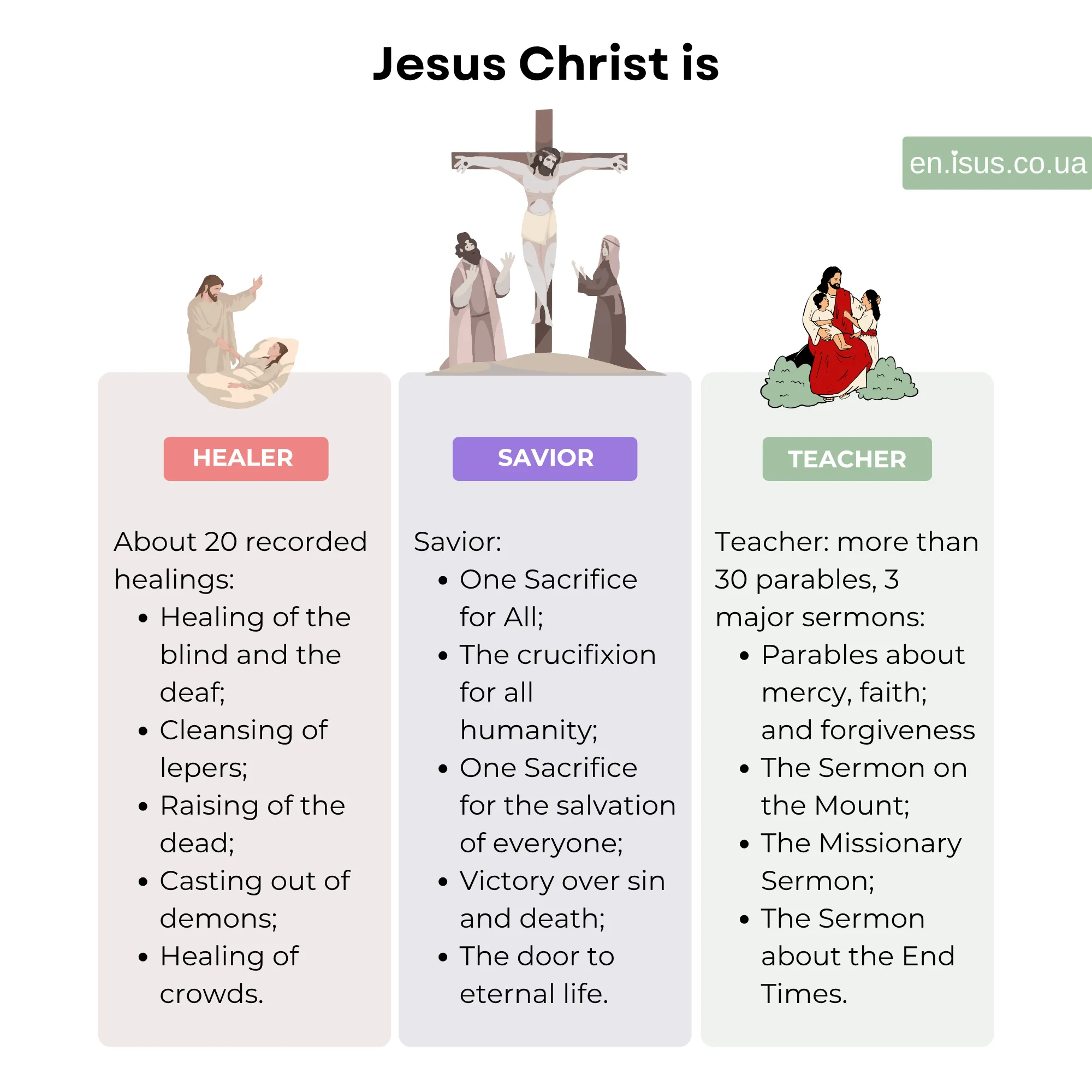
Jesus Christ lived a full, meaningful, and deeply purposeful life.
His mission embraced all dimensions – spiritual, social, physical, and personal.
Outwardly simple, yet inwardly profound, His actions touched hearts, healed lives, and renewed souls.
He did not come to be served, but to serve – with love, gentleness, and self-sacrifice.
His ministry can be seen on three main levels:
Teacher – Revealing the Truth of God
Jesus taught not like the scribes 📖, but as One with authority.
His words reached the depths of the human heart, spoken from intimate experience with the Father.
His teaching was alive, vivid, and understandable even to children 👶.
Practical characteristics of His teaching:
- He used parables: short stories from daily life that carried deep spiritual meaning
- He taught on the move: by the sea, on mountains, in homes, in the fields – His classroom was wherever people were
- He didn’t lecture – He engaged: asking questions, sparking reflection, teaching through examples
The heart of His message: love, mercy, the Kingdom of God, repentance, and forgiveness.
Examples of His parables:
- The Good Samaritan – mercy beyond boundaries
- The Prodigal Son – the Father’s unconditional love
- The Sower – how hearts receive the Word of God
His words changed lives – not by complexity, but by truth spoken in love.
Healer – Restoring Wholeness
Jesus did not only speak – He acted.
He approached human suffering with profound tenderness.
His healings were never performances, but acts of deep compassion.
He never ignored pain – physical, emotional, or spiritual.
Types of His healing:
- Physical: gave sight to the blind, cleansed lepers, raised the paralyzed
- Spiritual: freed people from evil spirits, forgave sins, removed guilt
- Emotional: healed the heart 💚 – welcoming the rejected, listening to the weary, uplifting the outcast
These healings always happened:
- Through the faith of the person or their loved ones.
- With love and a personal touch.
- Without charge, demands, or fear.
He never healed for fame.
Often, He even asked people not to tell others.
His goal wasn’t just to ease suffering, but to restore dignity, give hope, and open hearts to God.
Savior – Freely Embracing the Cross and Death
The climax of Jesus’ mission was His death and resurrection.
He willingly accepted suffering, knowing it was the only way to save humanity.
His mission was not just to teach or heal – but to give Himself for each of us.
As Savior, Jesus:
- Lived without sin to be the perfect sacrifice
- Showed absolute love – forgiving His enemies even on the cross
- Rose again, defeating death and offering eternal life
His sacrifice was:
- Conscious – He knew what awaited Him
- Voluntary – No one forced Him
- Universal – For everyone, regardless of their past
This is not just history – it’s a world-changing event.
Through His death, we receive forgiveness, hope, a new heart, and a new life.
Jesus became the Bridge 🌈 between God and humanity.
Jesus Christ is not merely a historical figure.
He was, is, and always will be the source of light, joy, and love.
What He did then, still has power today – to teach the heart, heal the soul, and save the life.
Jesus – An Example for All
For Children – Obedience to Parents
As a child in the home of Mary and Joseph, Jesus showed deep respect, obedience, and love for His parents.
Luke’s Gospel tells us He “was obedient to them” and “grew in wisdom, stature, and favor with God and people.”
This means He not only fulfilled family duties but also grew spiritually, intellectually, and socially in harmony with both heaven and earth.
Every child should take this to heart: Obedience doesn’t belittle – it shapes maturity, understanding, and love.
Being obedient means more than doing what you’re told – it means cooperating with trust and sincerity with loving parents who guide and care.
Practical tip: If it’s hard to obey or you disagree with a decision – talk to your parents openly and respectfully.
Jesus too asked questions and spoke sincerely, but always remained obedient.
For Professionals – Work as a Vocation
Until the age of thirty, Jesus worked with Joseph.
He didn’t seek palaces or fame, nor did He avoid hard labor.
His profession – tekton – included woodworking, stonework, construction skills, planning, endurance, and client service.
It was demanding, responsible, and valuable.
Through work, Jesus entered real human life, understood people’s needs, valued honest labor, and knew the worth of bread 🍞 and the labor of hands 🙌.
His example teaches: Dignity doesn’t come from status, but from your attitude toward your work.
You may be a programmer, teacher, cook, doctor, builder, or musician – if you work with love, honesty, and integrity, you already reflect Christ.
Practical tip: Don’t undervalue your job – even if it feels routine. Jesus chose a humble trade and glorified God through it.
Work as if for Him – with truth, responsibility, and kindness.
For Seekers – In Prayer
Jesus constantly prayed.
He withdrew into silence, sought solitude, spent nights in conversation with the Father.
He prayed 🙏 before major decisions, after miracles, before suffering, during temptation, and even on the cross.
Prayer was not a ritual – it was His living connection with Love, the source of strength, peace, joy, and clarity.
He showed that anyone can pray.
No special words or conditions are needed – only sincerity.
Prayer is when you open your heart to God and trust Him with everything: fears, plans, thanks, requests.
Practical tip: Even 2 minutes of honest prayer morning or night can change your mood, your day, and your life.
Start simple – say, “Thank You, God, for my life. Help me love like You.”
Repeat it daily – with a smile in your heart.
Conclusion: Jesus – a Model of Fullness, Love, and Meaning
Jesus is not a distant image, but a Friend who showed the way:
- For children – a path of trust and obedience
- For adults – a path of dignified work
- For all – a path of love for the Father through prayer
His life is a model of complete humanity, where every step is filled with purpose, joy, and care for others.
To follow Jesus means being truly human – in family, in work, and in spirit.
Final Reflection: The Life of Jesus – A Pattern of Love and Fulfillment
The life of Jesus Christ is not just a story of the past.
It’s a key to deeply understanding human dignity, purpose, and the power of love – a love that doesn’t seek its own, but gives itself completely.
How His life inspires us today:
- In humility – the path to greatness.
Jesus lived in a humble home, obeyed His parents, worked an ordinary job.
Holiness begins in daily faithfulness, simplicity, and responsibility.
Whether you’re cooking, working, parenting, or studying – you are within God’s loving presence. - In love – the force that conquers all.
Jesus had no sword, wealth, or political power – yet He changed the world more than any empire.
His weapon was love that heals, accepts, serves, and forgives.
When you support someone, pray for enemies, or forgive – you’re walking His path. - In service – true power.
He washed His disciples’ feet. Not humiliation, but true greatness.
Every good deed of yours shines with His light: feeding the hungry, comforting the sad, sharing bread or kind words. - In prayer – source of strength.
Jesus often withdrew to be with the Father. Prayer wasn’t a duty – it was the breath of His heart.
When you pause to silently entrust your thoughts to God – you enter the same spiritual reality. - In suffering – victory.
He did not run from pain or the cross.
He endured the hardest path and opened the way to resurrection.
Your struggles are not the end, but a chance for God to act.
Patience in love is the seed of future fruit.
What we can learn from each phase of His earthly journey:
- Childhood – learn obedience and trust. You don’t need to understand everything to be faithful
- Youth – honor work, honesty, and family
- Before 30 – be patient in preparation, even if unnoticed
- Public ministry – live in truth, help people, shine light in darkness
- Passion – face fear, pain, betrayal – and keep loving
- Resurrection – believe that after the night comes the morning
Why His simple life was revolutionary:
- It restores human value. He spoke with a Samaritan woman, touched lepers, defended women, blessed children. In His eyes, everyone is valuable, beloved, worthy
- It reverses worldly logic. To be first – be last. To gain – let go. To live – die to self. His way is freedom, not fear
- It shows that love is not a feeling, but an action. To love is to do good. Every day, every moment is a chance to do something good – small but real
- It reveals that God is near. He is not far off. He is in Nazareth, on your street, in your heart, in kind words, in merciful glances, in every seeker of light
The life of Jesus is not just a model.
It’s an invitation.
To follow Him doesn’t mean to be perfect – it means to be open to love, truth, and service.
He awaits you not at the peak of perfection, but right here and now – within your heart ❤️.