
The Power of Psalms in Daily Life
Psalms are not just poetic texts.
Table Of Content
- The Power of Psalms in Daily Life
- Psalm 91
- Psalm 103
- What Are the Psalms and Why Are They Important
- When the Psalms Are Read
- Psalm 50
- Psalms for Various Needs
- Psalms for Children
- Psalm 127
- Psalms of Thanksgiving
- Psalm 33
- Psalm 99
- Psalm 117
- Which Psalms to Read for Health
- Psalm 6
- Psalm 38
- Psalm 145
- Psalms in Ukrainian language
- What Are Psalms and Why Are They Important
- Psalm 89
- The Psalms of David: The Voice of a Heart That Lives Forever
- Practical Tips to Make Psalms a Part of Your Heart
- Psalms for Children: Prayerful Protection and Blessing
- Psalms for Health and Healing
- Psalm 38
- Psalms of Thanksgiving
- Gratitude for Everything – even Difficulties
- What Helps Develop a Thankful Heart
- Psalms in Times of Anxiety, War, and Loss
- Psalm 27
- Psalm 61
- Psalm 143
- Table of Psalms for Times of Trial
- Psalm 121
- Psalms in the Ukrainian Language: Why It Matters
- Key Ukrainian Translations of the Psalter
- How to Read Psalms Properly
- Prayer After Reading a Psalm
- Keeping a Psalm Journal
- Psalm 84
- Living Testimonies: How Psalms Change Lives
- Psalm 4
- Psalm 3
- Living Testimonies: How Psalms Transform Lives
- Testimonies: Psalms that Changed a Day, a Month, a Life
- Psalm 91
- A Mother and God’s Protection Over Her Children
- The Gentle Power of God’s Word in a Person’s Life
- Psalm 50
- Psalm 1
- Psalms are not theory.
- Conclusion
They are prayers that have endured thousands of years, preserving tenderness, strength, and sincerity.
They are words that speak directly to the heart.
Each psalm reflects real life: joy and despair, gratitude and pleading, hope and struggle.
These texts give a voice to those who no longer know what to say to God.
In them, the soul cries out – and feels heard.
Psalms unite people across all eras, nations, and walks of life.
They are close to those in the light, and to those in darkness.
David, who once hid from his enemies, left us words that still help us today.
A mother worried about her child finds comfort in Psalm 91.
Below are author-adapted versions of the Psalms for free use.
Psalm 91
Whoever dwells in the shelter of the Most High
will rest in the shadow of the Almighty.
They will say of the Lord,
“You are my refuge and my fortress,
my God, in whom I trust.”
He will save you from the enemy’s trap,
from deadly danger.
He will cover you with His feathers,
and under His wings you will find safety.
His faithfulness will be your shield and support.
You will not fear the terror of night,
nor the arrow that flies by day,
nor the pestilence that stalks in darkness,
nor the plague that destroys at midday.
A thousand may fall at your side,
ten thousand at your right hand,
but it will not come near you.
You will only observe with your eyes
and see the punishment of the wicked.
Because you say, “The Lord is my refuge,”
and make the Most High your dwelling,
no harm will overtake you,
no disaster will come near your home.
For He will command His angels
to guard you in all your ways.
They will lift you up in their hands,
so that you will not strike your foot against a stone.
You will tread on lions and snakes,
trample young lions and dragons.
“Because he loves Me,” says the Lord,
“I will rescue him.
I will protect him, for he knows My name.
When he calls on Me, I will answer.
I will be with him in trouble,
I will deliver and honor him.
With long life I will satisfy him
and show him My salvation.”
A person recovering from illness reads Psalm 103 and learns to give thanks.
Psalm 103
Bless the Lord, O my soul,
and all that is within me, bless His holy name!
Bless the Lord, O my soul,
and forget not all His benefits
Who forgives all your sins,
and heals all your diseases,
Who redeems your life from destruction,
and crowns you with mercy and love,
Who fills your life with good things
so that your youth is renewed like the eagle’s.
The Lord works righteousness and justice
for all who are oppressed.
He made known His ways to Moses,
His deeds to the children of Israel.
The Lord is merciful and gracious,
slow to anger and abounding in love.
He will not always accuse,
nor will He harbor His anger forever.
He does not treat us as our sins deserve
or repay us according to our iniquities.
For as high as the heavens are above the earth,
so great is His love for those who fear Him.
As far as the east is from the west,
so far has He removed our transgressions from us.
As a father has compassion on his children,
so the Lord has compassion on those who fear Him.
For He knows how we are formed,
He remembers that we are dust.
The life of a man is like grass,
he flourishes like a flower of the field.
The wind blows over it and it is gone,
and its place remembers it no more.
But from everlasting to everlasting
the Lord’s love is with those who fear Him,
and His righteousness with their children’s children
with those who keep His covenant
and remember to obey His commands.
The Lord has established His throne in heaven,
and His kingdom rules over all.
Praise the Lord, you His angels,
you mighty ones who do His bidding,
who obey His word.
Praise the Lord, all His heavenly hosts,
you His servants who do His will.
Praise the Lord, all His works,
everywhere in His dominion.
Bless the Lord, O my soul!
Psalms are the Word of God that walk with you wherever you go.
This material will help you find the right psalm at the right moment.
Here you’ll find psalms for children, psalms of thanksgiving, psalms for healing, psalms in Ukrainian, explanations of what psalms are, who wrote them, and when they are read.
For your convenience – clear recommendations, selected collections, and practical guidance.
What Are the Psalms and Why Are They Important
The Psalms are a biblical book containing 150 prayers and songs.
Most of them were written by King David – a man of prayer, music, and deep sorrow.
Other authors include Asaph, the sons of Korah, Solomon, Moses, and others.
David’s psalms hold a special place – they are filled with deep trust in God, even in the hardest moments.
The Psalms are spiritual poetry that breathes with living emotion.
They are prayers through which one can speak to God sincerely, directly, and with childlike openness.
They carry inner strength and comfort when all other words fall silent.
That is why the Psalms are read in church, at home, in hospitals, and before sleep.
When the Psalms Are Read

Psalms are read in the morning, in the evening, in sorrow, in joy, during fasting, and in times of great distress.
In liturgical life, Psalms form the foundation of Matins, Vespers, and the canonical hours.
Psalm 50 is read after confession.
Psalm 50
Have mercy on me, O God,
according to Your unfailing love.
Cleanse me with Your mercy,
forgive all my transgressions.
Wash away the stain of my sin,
purify me deep within.
I acknowledge my guilt,
it is always before me.
I have sinned against You
and done what is displeasing to You.
You are just in all You do,
and Your judgment is true and pure.
I was born with weakness within,
sin has been with me from the beginning.
But You desire truth in the heart,
You teach me wisdom in secret.
Cleanse me, and I shall be clean.
Wash me, and I shall be whiter than snow.
Restore to me joy
and fill me with new life.
Do not hide Your face from me,
and do not take away Your Holy Spirit.
Restore to me the joy of salvation,
and strengthen me with a spirit of kindness.
I will teach others Your ways,
and sinners will return to You.
Deliver me from the guilt of death,
and my tongue will praise You.
Lord, open my lips –
and my heart will sing to You.
You do not desire animal sacrifices,
but a sincere and contrite heart.
Such a heart You will not reject, O God.
Have mercy on Your people,
restore what is broken.
Let the holy place be rebuilt,
and sincere offerings of gratitude be brought.
Psalm 90 is read as a spiritual shield.
Psalm 103 is read in times of thanksgiving.
The Psalter can be read daily – just a few lines or chapters.
It is good when Psalms become a personal spiritual habit.
They are like bread that sustains the soul.
Psalms for Various Needs
Psalms are prayers for every situation in life.
They support, heal, and guide.
Below is a selection of Psalms for specific needs with brief explanations.
| Need | Recommended Psalms |
|---|---|
| Protection of a child | 90, 127, 103 – for peace, protection, and blessing |
| Thanksgiving to God | 33, 99, 117 – as a song of heartfelt praise |
| For health | 6, 38, 103, 145 – prayers for healing |
| Peace before sleep | 4, 91, 121 – Psalms that calm the soul |
| Repentance | 50, 32, 38 – Psalms of deep heart purification |
| In fear or anxiety | 26, 60, 143 – words of hope and trust |
| For peace and calm in the soul | 27, 61, 62 – prayers for inner peace |
| In times of inner struggle | 3, 17, 140 – Psalms of spiritual resilience |
Psalms for Children
Praying the Psalms for children is a tender, powerful, and deeply spiritual act.
Psalm 90 – as a shield, Psalm 127 – as a blessing for the future, Psalm 103 – as a prayer for healing.
Psalm 127
Unless the Lord builds the house –
the builders labor in vain.
Unless the Lord watches over the city –
the guard stands watch in vain.
It is in vain you rise early
and go late to rest,
eating the bread of anxious toil –
for He gives sleep to His beloved.
Children are a gift from the Lord,
the fruit of the womb is His reward.
Like arrows in the hands of a warrior
are the sons of youth.
Blessed is the one
whose house is full of them.
They will not be ashamed
when they stand at the gates
and speak with their enemies.
It is good to read aloud before bedtime while holding the child’s hand.
Even better – together with the child.
Psalms have no age restrictions.
They are written for everyone with a heart.
Psalms of Thanksgiving
Thanksgiving is strength.
It changes perception, cleanses the heart, and opens the eyes to God’s presence.
Psalm 33 – about trust.
Psalm 33
Rejoice in the Lord, you who love truth,
let your hearts praise Him without fear or hesitation.
Sing to Him a new song,
play with joy and tenderness of soul.
For the word of the Lord is faithful,
and all His works are just.
He loves righteousness and justice;
the earth is full of His mercy.
By His word the heavens were made,
by His breath – the stars above.
He gathered the seas like in a jar,
put the deep into storehouses.
Let all the earth fear the Lord,
let all people tremble at His voice.
For He spoke – and it came to be,
He commanded – and it stood firm.
The Lord frustrates the plans of nations,
He thwarts the schemes of the mighty,
but His purpose stands forever,
His will through all generations.
Blessed is the nation whose God is the Lord,
the people He has chosen as His own.
The Lord looks down from heaven,
He sees all who dwell on the earth.
He knows every heart,
He sees every thought and way.
A king is not saved by the size of his army,
a warrior is not delivered by his strength.
A horse is a vain hope for salvation,
human pride is not our fortress.
The eyes of the Lord are on those who fear Him,
on those who hope in His mercy.
He delivers their soul from death,
and sustains them in famine.
Our soul waits in quiet before the Lord,
for we trust in Him.
He is our strength and shield.
Our hearts rejoice, for we trust in His name.
Let Your mercy be upon us, O Lord,
for we place our hope in You.
Psalm 99 – about joy.
Psalm 99
Shout joyfully to the Lord, all the earth!
Serve Him with gladness,
come before Him with singing!
Know that the Lord is God.
He made us, and we are His.
We are His people,
the sheep of His pasture.
Enter His gates with thanksgiving,
His courts with praise.
Give thanks to Him,
bless His name!
For the Lord is good,
His mercy is everlasting,
and His faithfulness continues through all generations.
Psalm 117 – about God’s goodness.
Psalm 117
Give thanks to the Lord, for He is good!
His mercy endures forever.
Let Israel say:
“His mercy endures forever.”
Let the house of Aaron say:
“His mercy endures forever.”
Let those who fear the Lord say:
“His mercy endures forever.”
In my distress I called to the Lord –
He answered me and gave me freedom.
The Lord is with me, I will not fear –
what can man do to me?
The Lord is my helper and protector.
I look with joy on my enemies,
for I know I am not alone.
It is better to trust in the Lord
than to rely on people.
It is better to trust in God
than to seek help from the mighty.
Surrounded by enemies,
but in the name of the Lord I will prevail.
They encircled me on all sides –
but they fell, for the Lord is my shield.
They raged like fire in dry grass,
but were extinguished – for the Lord’s name is stronger.
I was pushed hard, about to fall,
but the Lord upheld me.
He is my strength, my song,
and my salvation.
In the tents of the righteous – joy and triumph:
“The right hand of the Lord does mighty things!”
The right hand of the Lord is exalted,
it is victorious.
I will not die but live,
and declare the works of the Lord.
He disciplined me,
but did not leave me to death.
Open to me the gates of righteousness –
I will enter and give thanks to the Lord!
These are the gates of the Lord –
the righteous shall enter through them.
I give thanks to You, Lord, for You heard me
and became my salvation.
The stone the builders rejected
has become the cornerstone.
This is the Lord’s doing,
and it is marvelous in our eyes.
This is the day the Lord has made –
let us rejoice and be glad in it!
O Lord, save!
O Lord, bless!
Blessed is he who comes in the name of the Lord!
We bless you from the house of the Lord.
The Lord is God, and He gives us light.
Offer Him thanksgiving,
adorn the sacrifice with garlands of joy –
even to the horns of the altar.
You are my God – I will praise You.
You are my God – I will exalt You!
Give thanks to the Lord, for He is good!
His mercy endures forever!
It is good to read these Psalms in the morning when you wake, or in the evening when giving thanks for the day.
Gratitude is not only for the big things, but also for the small: for bread, for a smile, for a quiet night.
Which Psalms to Read for Health
Psalm 6 – A prayer in sickness.
Psalm 6
Lord, do not rebuke me in Your anger
or discipline me in Your wrath.
Have mercy on me, Lord,
for I am weak.
Heal me,
for my bones are trembling,
and my soul is in deep anguish.
How long, Lord?
Turn to me with love.
Save my life,
for Your mercy is greater than justice.
In death, no one remembers You;
in the grave – who will praise You?
I am worn out from groaning;
every night I flood my bed with tears,
my tears soak my pillow.
My eyes grow dim with grief,
my heart is broken and weary.
Away from me, all you evildoers,
for the Lord has heard my weeping.
He has heard my prayer,
received my plea.
All my enemies will be ashamed,
confused, and vanish,
they will turn away in disgrace – quickly,
for the Lord is my Shelter and my Peace.
Psalm 38 – Deep repentance.
Psalm 38
Lord, my hope is in You.
Do not rebuke me in Your anger,
do not pour out the heat of Your wrath on me.
For You know I am weak –
my body aches,
my soul is faint.
My sins have become a burden
too heavy for me to bear.
My heart is troubled,
life has lost its taste.
I fall and wither,
all day I walk bowed down,
like a shadow descending into evening.
Inside – wounds
I’ve inflicted on myself.
Lord, You know every sigh of mine,
nothing is hidden from You.
Even when I am silent –
You hear all my heart says.
My strength is gone,
my eyes have faded,
and my friends stand far off.
But You – are near.
You see me waiting for You.
I do not justify myself,
I do not search for the guilty –
I plead for mercy.
For You, Lord, are my Savior.
Do not forsake me, my God.
Be near when I fall.
Be light when all grows dark.
You are my only Hope.
Psalm 103 – Gratitude for healing.
Psalm 145 – Proclaiming God’s power over body and soul.
Psalm 145
I will exalt You, my God and King,
and bless Your Name forever and ever.
Every day I will praise You
and never cease to give thanks.
Great is the Lord, worthy of highest praise,
and His greatness has no limit.
One generation will commend Your works to another
and declare Your mighty acts.
I will meditate on the glorious splendor of Your majesty
and on Your wondrous works.
People will speak of the power of Your awesome deeds
and proclaim Your greatness.
They will celebrate Your abundant goodness
and joyfully sing of Your righteousness.
The Lord is gracious and full of compassion,
slow to anger, abounding in love.
The Lord is good to all,
and His mercy is over all He has made.
Let all Your works praise You, Lord,
and let Your faithful people bless You.
Let them tell of the glory of Your Kingdom
and speak of Your might.
Your Kingdom is an everlasting Kingdom,
and Your dominion endures through all generations.
The Lord upholds all who fall
and lifts up all who are bowed down.
The eyes of all look to You in hope,
and You give them their food at the proper time.
You open Your hand
and satisfy the desires of every living thing.
The Lord is righteous in all His ways
and faithful in all He does.
He is near to all who call on Him in truth.
He fulfills the desires of those who fear Him,
He hears their cry and saves them.
The Lord watches over all who love Him,
but all the wicked He will destroy.
My mouth will speak in praise of the Lord,
and may every heart bless His holy Name
now and forevermore.
Read in silence if possible.
If you are praying for someone else – say their name.
God hears both in silence and in cries.
Healing comes not only to the body, but also to the heart.
Psalms in Ukrainian language
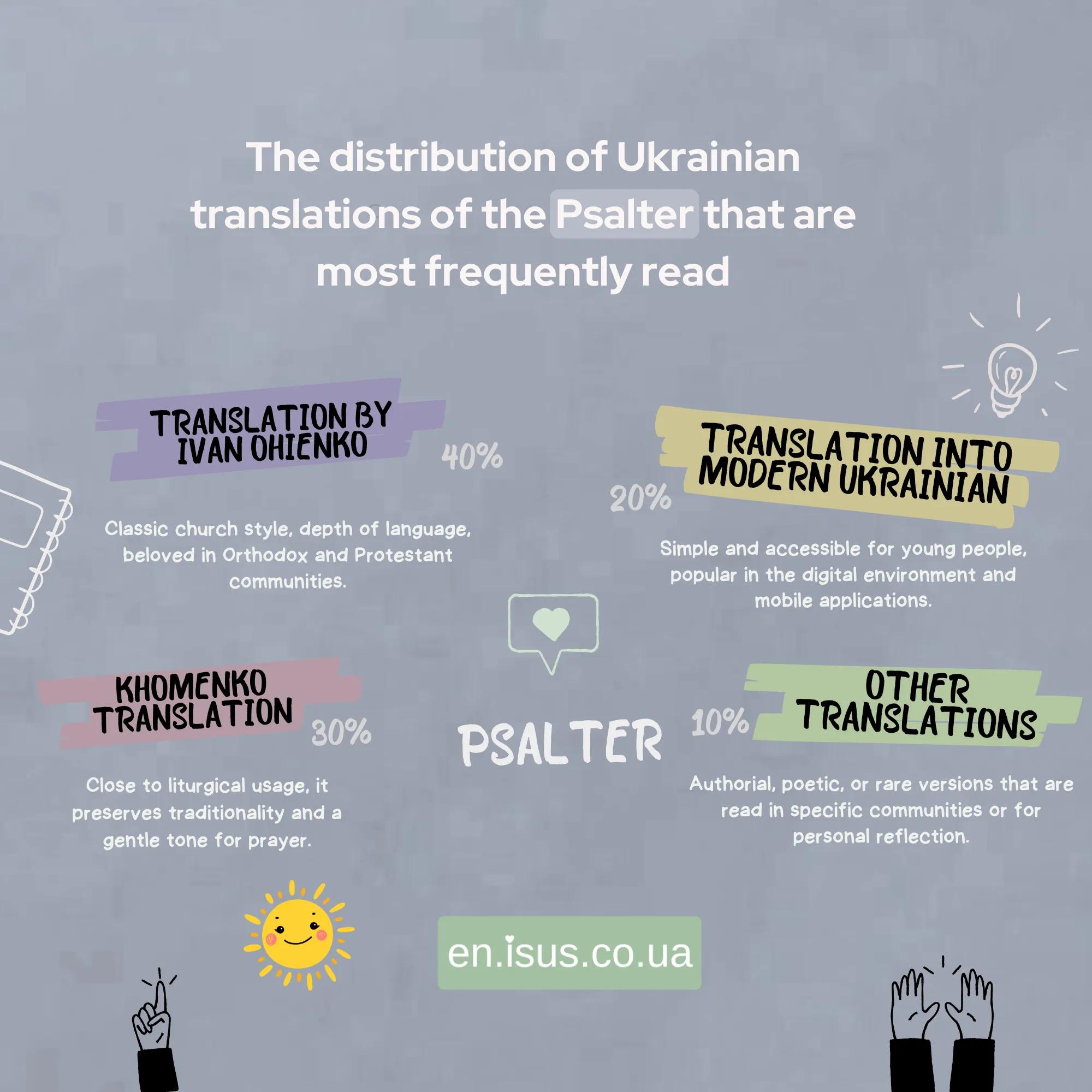
Psalms in one’s native language have a special sound.
They can be understood, experienced, and shared.
The most common Ukrainian translations are by Ivan Ohienko (deep and poetic), Ivan Khomenko (readable and liturgical), and modern versions tailored for teens and youth.
You can read them online, in print, or listen to them in audio format.
It’s a blessing to have a personal Psalter at home – with bookmarks, notes, and underlinings.
It becomes more than a book – it turns into a prayerbook of the heart.
Practical Tips for Daily Reading
- Set aside 10-15 minutes a day for one psalm
- Read slowly and thoughtfully. If a line touches you – pause and pray it
- Revisit your favorite psalms – they speak in new ways on different days
- Write your reflections and prayers in a notebook
- Share psalms with others – on a card, in a message, in conversation. A psalm sent at the right time can feel like a hug from God
What Are Psalms and Why Are They Important
Psalms are special prayers that God left us in the Bible as treasures for the soul.
The Book of Psalms contains 150 poetic, sincere, and profound texts – not born in quiet offices, but in the hearts of living people walking through pain, victory, loss, joy, repentance, and hope.
They’re not just words – they’re songs and prayers that breathe life.
Kings, prophets, shepherds, mothers, and warriors read them.
Today, they remain a source of strength for millions of hearts.
Most psalms were written by King David – a man with an open heart and a difficult life.
He was a shepherd, a persecuted refugee, a king, a sinner, a warrior, and a worshiper of God.
That’s why his psalms are so diverse: some are filled with joy, others soaked in tears.
He authored over 70 psalms.
Each is a voice of a living soul, addressed to God in trust and love.
Other authors include:
- Asaph – a Levite, prophet, and singer in God’s temple
- The Sons of Korah – a priestly family of musicians serving in the sanctuary
- Solomon – David’s wise son, author of several psalms, including deeply philosophical ones
- Moses – the prophet and leader, author of Psalm 89, one of the oldest in the Psalter
Psalm 89
Lord, You have been our refuge
through all generations.
Before the mountains were born,
before the earth and world were formed –
You were, You are, You are the eternal God.
You return man to dust
and say, “Return, children of earth.”
For a thousand years in Your sight
are like a day just gone by,
like a moment in the night.
You sweep them away like a flood,
they are like a dream,
like grass that sprouts in the morning,
but withers and dries up by evening.
We are consumed by Your breath,
our sins are laid bare before You,
even our secret thoughts –
in the light of Your gaze.
Our days pass like a sigh,
our years like a fleeting breath.
Seventy years are given to man,
and if strong – eighty,
but their sum is toil and sorrow,
for they quickly pass, and we vanish.
Teach us to number our days,
that we may gain a wise heart.
Return to us, Lord.
How long till Your mercy?
Satisfy us in the morning with Your kindness –
and we will rejoice all our days.
Give us joy in place of sorrow,
day by day, year by year,
for all the years we have suffered.
Show Your deeds to Your servants,
and Your glory to their children.
May the favor of the Lord be upon us,
establish the work of our hands,
strengthen all we do with You.
Each of these authors poured heart into the psalms.
These are prayers not only about God, but to God.
They are read in sorrow, when words fail.
They are sung in temples.
They are repeated when the world feels unstable and the soul longs for refuge.
Psalms are a spiritual tool for every day.
You can turn to them in any state:
- When you’re joyful – they teach you to praise God with gratitude
- When in pain – they allow you to pour out your heart
- When it’s dark – they kindle the light of God’s hope
- When you’re weak – they strengthen your faith in truth
It’s important not just to read psalms, but to let them shape your thoughts, habits, and actions.
Many people have a favorite psalm that always helps.
You can find yours too – and it will stay with you like a warm voice of a friend in your most important moments.
Psalms are the gentle voice of heaven echoing in your heart.
Read them with attention, love, and openness – and they will transform not just your day, but your whole life.
The Psalms of David: The Voice of a Heart That Lives Forever
The Psalms of David are not merely biblical poetry.
They are the breath of a living soul.
They are prayers born at night, beneath tears, in the desert, on the battlefield, in the royal palace, and in the solitude of a cave.
They are the voice of one truly seeking God in every state – from triumph to brokenness, from joy to repentance.
David wrote them – shepherd, musician, prophet, commander, poet, and sinner – who knew how to ask for forgiveness and how to praise the Lord with all his might.
He wasn’t perfect, but he was real.
That’s why the psalms touch every heart – because they contain all of human life, but directed heavenward.
Psalms aren’t museum pieces.
They’re spiritual instruments you can use every day.
Don’t read them only during services or grief.
Learn to apply them – as medicine, as a source of peace, as a reminder of God’s love and faithfulness.
How to Start Reading the Psalms of David Daily
- Choose a specific time of day – morning, evening, or a quiet moment
- Start with one psalm. Read it slowly, aloud
- Pause on a phrase that touches you. Repeat it several times
- Pray with that phrase. Add your own words as a continuation of the psalm
- Keep a simple journal: note what you understood and felt
Well-Known Psalms of David and When to Read Them
| Life Situation | Psalm |
|---|---|
| Fear, need for protection | Psalm 90 – “He who dwells in the shelter…” |
| Repentance, sense of guilt | Psalm 50 – “Have mercy on me, O God” |
| Gratitude, praise | Psalm 103 – “Bless the Lord, O my soul” |
| Night anxiety, insomnia | Psalm 4 – prayer before sleep |
| Morning awakening with faith | Psalm 5 – morning prayer |
| Asking for strength and help | Psalm 26 – “The Lord is my light” |
| Need for trust in God | Psalm 22 – “The Lord is my Shepherd” |
| War, danger | Psalm 143 – warrior’s prayer |
Practical Tips to Make Psalms a Part of Your Heart
- Download the Ukrainian Psalter (Ohienko or Khomenko) in PDF or an app
- Try a 30-day challenge: 5 psalms a day, and the whole Psalter in a month
- Write down one favorite verse daily in a journal
- Teach a child a psalm – one verse per week
- Create a bookmark with your favorite psalm – read it in difficult times
The psalms of David are words you can carry in the pocket of your heart.
They teach you to trust, even when you see no way out.
They do not hide tears, but lift your gaze to heaven through them.
Each psalm is a small world where the soul finds refuge.
And even if you have no strength to pray – the psalm will do it for you.
Because these words breathe, love, and lift.
Just like the God who inspired them.
Psalms for Children: Prayerful Protection and Blessing
God’s love for children is tender, strong, and constant.
It embraces every tear, every night fear, every moment of growth.
Psalms are not just poetic texts – they are living prayers that cover a child with spiritual protection and open heavenly blessing.
In hard times and joyful moments, psalms become a shield, a lullaby, a blessing, and peace for the child’s soul.
Especially when spoken by someone who loves them – mom, dad, grandma, or grandpa.
Psalms You Can Read for Children
| Psalm | Purpose |
|---|---|
| Psalm 90 | Protection, safety, peace before sleep |
| Psalm 127 | Blessing for the future, spiritual growth |
| Psalm 103 | Healing, physical and emotional renewal |
Psalm 90 is one of the most well-known and powerful psalms of protection.
It speaks of God’s shelter under the wings of the Most High.
This psalm is especially fitting before bedtime, so the child’s heart falls asleep in peace, knowing God is always watching.
Psalm 127 speaks about God’s involvement in building life.
It says, “Children are a heritage from the Lord.”
It’s a prayer for the child to grow up blessed, protected, spiritually strong, and guided by God into the future.
Psalm 103 is fitting for times of illness or emotional pain.
It describes God as the One who heals all diseases, forgives all sins, restores strength, and heals with love.
How to Pray Psalms for Children
- Pray aloud, gently and sincerely. Your voice calms the child. Don’t fear repeating the same psalm daily. Children memorize rhythm and words by heart.
- Pray together with the child. Let them say the first lines, or repeat after you. This builds trust, closeness, and openness to God.
- Explain in simple words what the psalm means. For example: “Psalm 90 says that God holds you like a baby bird under His wings.”
- Choose a regular time and place. Ideally – before bedtime or when leaving home. Let prayer become a safe habit.
- Write a personal “child’s psalm” together. Ask the child what they’re thankful for, what they fear, what they want to ask God. Write it down and add a short verse from the Bible – this teaches adult-like prayer with a child’s heart.
- When a child is sick or afraid – lay your hands gently on them and speak the psalm softly and lovingly. Don’t rush. Let every word sound like a prayer-hug.
Psalms are not a magic formula, but a living conversation with the heavenly father.
And when you pray for a child, God hears more than your words – He sees your heart.
And responds with love, care, and power beyond understanding.
A child’s soul is tender and open.
When it grows in the words of Scripture, it sinks deep roots into God’s goodness.
And through such simple, repeated, gentle prayers with the psalms, you are planting in the child something that will hold them even when you are no longer near.
Psalms for Health and Healing
Psalms are a special language of the heart through which we can turn to God in any condition: in joy, in loss, in fatigue, in sickness.
When the body suffers and the soul grows weak, the psalms not only sustain but also revive.
They do not replace medical help, but they create a spiritual atmosphere in which the heart is restored, fear loses its grip, and hope begins to breathe.
Praying with psalms in times of illness is not a formality.
It is a conversation with God, who heals deeper than any medicine can.
His touch is gentle, yet powerful.
He sees the pain – even the unspoken kind – and responds with silence, peace, and calm.
Here are some psalms that especially help during times of physical or emotional weakness.
They can be read as personal prayers – aloud or in a whisper – with faith and an open heart.
| Psalm | Content and Purpose |
|---|---|
| Psalm 6 | A prayer in time of illness. David turns to God with tears, asking for healing. This psalm is especially deep when the heart is weakened, and the body lacks strength. |
| Psalm 38 | A penitential prayer where physical and spiritual pain are closely intertwined. The psalm cleanses, offering a sense of renewal, a fresh start, and forgiveness. |
| Psalm 145 | A declaration of trust in the Lord as Healer, who “sets prisoners free,” “opens the eyes of the blind,” and “lifts up those who fall.” A psalm of joyful hope. |
Psalm 38
Lord, do not rebuke me in Your anger,
or discipline me in Your wrath.
For Your arrows have pierced me,
and Your hand has come down upon me.
There is no soundness in my body because of Your anger,
no health in my bones because of my sin.
My guilt has overwhelmed me
like a burden too heavy to bear.
My wounds fester and are loathsome
because of my foolishness.
I am bowed down and brought very low;
all day long I go about mourning.
My strength fails me;
even the light has gone from my eyes.
My heart has no joy.
My friends and companions avoid me
because of my wounds;
those who seek my life set traps,
those who wish me harm
whisper, plot, and scheme
all day long.
I am like the deaf, who cannot hear,
like the mute, who cannot speak.
I have become like one who does not hear,
whose mouth can offer no reply.
But I put my hope in You, Lord;
You will answer, Lord my God.
I said, “Lord, do not let them gloat
or exalt themselves when my foot slips.”
For I am about to fall,
and my pain is ever with me.
I confess my iniquity;
I am troubled by my sin.
Many have become my enemies without cause;
those who hate me wrongfully are numerous.
They repay me evil for good
and accuse me because I seek what is good.
Do not forsake me, Lord;
do not be far from me, my God.
Come quickly to help me,
my Lord and my Savior.
You may read these psalms one by one – one per day – or choose the one that touches your heart the most.
It’s good to have a printed Psalter, but if you don’t, they are easily found online, including in Ukrainian.
To make the psalms a deeper part of your healing, don’t just read them – pray through them:
- Before reading, close your eyes, take a deep breath, and say: “Lord, speak to my heart.”
- Read slowly. If a phrase touches you – pause, repeat it. It may be the word meant for you
- After reading, stay silent for a few minutes. Write down what you felt, what you understood, what you want to thank for or ask for
- If you know someone dear who is also ill – invite them to read the psalm with you. Or read it on their behalf, with love.
Healing is always a process.
Reading psalms does not cancel the need to see a doctor, take medicine, or care for the body.
But it brings what even the best medicine cannot – peace, faith, and inner strength.
God heals not only the body but also the heart.
He enters our sickness not with judgment, but with tenderness.
His presence is a remedy that can’t be bought at a pharmacy.
The psalms are His voice – you can hear it today.
Psalms of Thanksgiving
True gratitude begins not when everything is fine, but when you notice God’s faithfulness every day – in joy and in trials.
Psalms teach us not to give thanks just formally, but to live in gratitude as a condition of the heart.
It’s not about duty – it’s about love that sees God even in the darkness of the soul.
Psalm 33
“Rejoice in the Lord, you who love righteousness.”
This psalm is about constant thanksgiving, regardless of circumstances.
David wrote it while hiding, while in danger.
But his heart still gave thanks.
This psalm reveals a truth: praise is a choice, not just a reaction.
If you learn to praise God daily – even for simple things like a new morning, fresh air, kind people – your life will change.
Tip: Read this psalm in the morning, before starting your day. Aloud. Slowly. Add your own thanksgivings after each line. Let your heart enter into praise.
Psalm 99
“Shout for joy to the Lord, all the earth!”
This is a psalm of joyful gratitude – not quiet, but full of strength and celebration.
It teaches that God’s goodness is not temporary, but eternal.
He is good not because our life is good, but because He is Love.
Even in sorrow, you can say: “Lord, I don’t understand everything, but You are good – and I thank You.”
Insight: Gratitude expands the heart. When you give thanks, you don’t deny the reality of pain, but you let God’s love enter it. That’s why a prayer of thanksgiving is not an escape from problems, but a path to inner peace.
Psalm 117
“Give thanks to the Lord, for He is good!”
This psalm repeats that line like a song.
Simple words, yet incredibly powerful.
These were the words Jesus and His disciples sang after the Last Supper – right before Jesus was arrested.
It is a song of thanksgiving even in the midst of deepest sorrow.
It is a sign of mature faith – to thank God even when the Cross lies ahead.
Practice: Memorize this verse. Say it when it hurts, when you’re afraid, when you’re alone. It’s not a magic formula – it’s a foundation for a soul that cannot be shaken.
Gratitude for Everything – even Difficulties
In the Bible, thanksgiving is not limited to happy moments.
It appears even through tears.
Daniel gave thanks to God even when he knew it could get him thrown into the lions’ den.
Paul and Silas sang psalms in prison at night – not when they were freed, but before it.
Jesus gave thanks to the Father before His suffering.
This is true gratitude – not for comfort, but for God’s presence.
What Helps Develop a Thankful Heart
| Action | Practical Effect |
|---|---|
| Write down 3 things you’re thankful for every day | Builds the habit of seeing goodness |
| Start your prayer with “thank You,” not “please” | Shifts focus from problems to blessings |
| Give thanks out loud, even when alone | Your soul hears and is filled |
| Thank God for hardships as opportunities to grow | Develops mature, deep faith |
| Teach children to thank God for the day before bedtime | Cultivates spiritual thinking from an early age |
Thanksgiving psalms are not just literary beauty.
They are the breath of a heart that lives with God.
When you give thanks – even for the little things – you make room for greater things.
Gratitude changes the atmosphere.
It doesn’t remove problems, but it changes you – and you begin to see differently.
Give thanks sincerely, simply, even when it seems like nothing has happened.
Maybe the greatest miracle has already taken place – you are not alone.
And that is reason enough to praise.
Psalms in Times of Anxiety, War, and Loss
In moments when the world around trembles, when anxiety grips the chest, when pain seems endless, the Psalms become more than just words – they become breath.
They are prayers that have already passed through darkness and taught the heart to see light.
They are cries to God born from the depths of the soul, when there is nothing left to lean on but His faithfulness.
Psalm 27 – a prayer of trust in danger.
Psalm 27
The Lord is my light and my salvation –
whom shall I fear?
The Lord is the stronghold of my life –
of whom shall I be afraid?
When the wicked advance against me
to devour me,
it is they who stumble and fall.
Though an army besiege me,
my heart will not fear.
Though war break out against me,
even then I will be confident.
One thing I ask from the Lord,
this only do I seek:
that I may dwell in the house of the Lord
all the days of my life,
to gaze on the beauty of the Lord
and to seek Him in His temple.
For in the day of trouble
He will keep me safe in His dwelling;
He will hide me in the shelter of His sacred tent
and set me high upon a rock.
Then my head will be exalted
above the enemies who surround me;
at His sacred tent I will sacrifice with shouts of joy;
I will sing and make music to the Lord.
Hear my voice when I call, Lord;
be merciful to me and answer me.
My heart says of You, “Seek His face!”
Your face, Lord, I will seek.
Do not hide Your face from me,
do not turn Your servant away in anger;
You have been my helper.
Do not reject me or forsake me,
God my Savior.
Though my father and mother forsake me,
the Lord will receive me.
Teach me Your way, Lord;
lead me in a straight path
because of my oppressors.
Do not turn me over to the desire of my foes,
for false witnesses rise up against me,
spouting malicious accusations.
I remain confident of this:
I will see the goodness of the Lord
in the land of the living.
Wait for the Lord;
be strong and take heart
and wait for the Lord.
It rings with certainty: “The Lord is my light and my salvation – whom shall I fear?”
In moments of fear, these words turn the heart back to hope.
It can be read before leaving the house, before a long journey, before tough decisions, or even during an air raid alert.
Repeat the lines slowly and thoughtfully, letting each word wrap your soul in truth.
Psalm 61 – a prayer from the depth of despair.
Psalm 61
Hear my cry, O God;
listen to my prayer.
From the ends of the earth I call to You,
I call as my heart grows faint;
lead me to the rock
that is higher than I.
For You have been my refuge,
a strong tower against the foe.
I long to dwell in Your tent forever
and take refuge in the shelter of Your wings.
For You, God, have heard my vows;
You have given me the heritage of those who fear Your name.
Increase the days of the king’s life,
his years for many generations.
May he be enthroned in God’s presence forever;
appoint Your love and faithfulness to protect him.
Then I will ever sing in praise of Your name
and fulfill my vows day after day.
David cries out: “From the ends of the earth I call to You, as my heart grows faint.”
This psalm is for the exhausted, the confused, those who see no way out.
If it’s hard to pray with your own words – read this psalm aloud, verse by verse, repeating the lines that move you most.
Weeping before God is not weakness – it is the road to healing.
Psalm 143 – a cry from a wounded heart.
Psalm 143
Lord, hear my prayer,
listen to my cry for mercy;
in Your faithfulness and righteousness
come to my relief.
Do not bring Your servant into judgment,
for no one living is righteous before You.
The enemy pursues me,
he crushes me to the ground;
he makes me dwell in the darkness
like those long dead.
So my spirit grows faint within me;
my heart within me is dismayed.
I remember the days of long ago;
I meditate on all Your works
and consider what Your hands have done.
I spread out my hands to You;
I thirst for You like a parched land.
Answer me quickly, Lord;
my spirit fails.
Do not hide Your face from me
or I will be like those who go down to the pit.
Let the morning bring me word of Your unfailing love,
for I have put my trust in You.
Show me the way I should go,
for to You I entrust my life.
Rescue me from my enemies, Lord,
for I hide myself in You.
Teach me to do Your will,
for You are my God;
may Your good Spirit
lead me on level ground.
For Your name’s sake, Lord, preserve my life;
in Your righteousness, bring me out of trouble.
In Your unfailing love, silence my enemies;
destroy all my foes,
for I am Your servant.
There is no embellishment here, only honesty: “In Your mercy, bring my soul out of darkness.”
This psalm is especially needed by those who have experienced loss, pain, or farewell.
It is good to read in silence, in the evening, with a lit candle, allowing your heart to speak with the psalmist.
When you read Psalms during war, anxiety, or grief, you are not alone in your pain.
These words have served for thousands of years as a refuge for the weary, confused, and wounded.
They have been read in caves, on battlefields, in hospitals, in camps, and in trenches – and they have always brought peace.
Practical Tips for Daily Psalm Reading in Difficult Times:
- Choose one psalm and read it every day for a week. Let it become your spiritual companion
- Read slowly, attentively. If your heart reacts to a certain verse – pause and repeat it several times
- If you have no strength at all – take just one line. Even one breath of a psalm is a prayer
- Keep a “Psalm journal”: write down what touched you, what thoughts supported you, what tears brought you hope
Table of Psalms for Times of Trial
| Situation | Recommended Psalm |
|---|---|
| Fear, danger | Psalm 27 |
| Exhaustion, despair | Psalm 61 |
| Loss, deep grief | Psalm 143 |
| Threat of war, shelling | Psalm 91, Psalm 46 |
| Prayer for soldiers | Psalm 33, Psalm 27 |
| Protection for the home | Psalm 121 |
Psalm 121
I lift up my eyes to the mountains –
where does my help come from?
My help comes from the Lord,
the Maker of heaven and earth.
He will not let your foot slip –
He who watches over you will not slumber;
indeed, He who watches over Israel
will neither slumber nor sleep.
The Lord watches over you –
the Lord is your shade at your right hand;
the sun will not harm you by day,
nor the moon by night.
The Lord will keep you from all harm –
He will watch over your life;
the Lord will watch over your coming and going
both now and forevermore.
Testimonies of Believers Who Endured Through the Psalms:
A soldier said he reads Psalm 91 before each mission and keeps a small printout in his pocket.
He believes it is his shield.
A mother who lost her home in a missile strike said Psalm 61 helped her not to break.
She read it every morning, cried, but always felt peace return after the prayer.
A young woman who lost her father kept a Bible close and read Psalm 143 each night.
It became her way of staying in God’s love when everything else was falling apart.
Psalms do not remove pain instantly, but they wrap the soul like a gentle cloth over a wound.
They help the heart to breathe when it feels like there’s no more air.
And they always lead to the One who never leaves – even in the darkest hour.
Read the Psalms with trust.
Read with hope.
Read with faith that you are not alone.
And you will see how every word is not just text, but God’s presence in your battle.
Psalms in the Ukrainian Language: Why It Matters
When the Psalms are heard in your native language, they touch not only the mind but also the heart.
You’re not just hearing a translation – you’re hearing a voice that is close.
A word the soul understands effortlessly.
It’s like speaking to the Heavenly Father in the language you prayed in as a child, the language of blessings, the one you whisper your deepest requests in.
The Ukrainian language brings God’s Word closer, clearer, and alive.
Your native tongue adds warmth and emotional depth.
Where a foreign language might sound solemn but distant, Ukrainian sounds tender, gentle, and melodic.
Psalms in Ukrainian are especially easy to memorize, convenient to pray with, sing, and share with children.
When you read a Psalm in your native language, it becomes part of you. It’s not just on paper – it’s inside you.
Key Ukrainian Translations of the Psalter
| Translation Name | Characteristics |
|---|---|
| Ivan Ohienko’s Translation | Classical literary style, deep, close to church language |
| Ivan Khomenko’s Translation | More modern and simple, well suited for reading aloud |
| Ukrainian Bible Translation (UBIO) | Clear structure, good balance of accuracy and clarity |
| Rafail Turkoniak’s Translation | Closer to the Greek text, used in Ukrainian Orthodox tradition |
| Poetic Versions (modern authors) | Suitable for children, creative reading, singing |
Each of these translations has its own tone, style, and beauty.
We recommend choosing the one that resonates most with your heart – or keeping several for different moods, depths, or seasons of life.
How to Read Psalms Properly
Psalms are not just lines from the Old Testament.
They are a living, warm, and profound conversation with the Heavenly Father.
They should be read not as a ritual, but as a sincere prayer of the heart that transforms the soul.
Every word has power.
It can comfort, inspire, support, heal a wounded heart, or give strength to take a new step in life.
Read the Psalms slowly, pause on the lines that move you.
Repeat them aloud or silently several times.
If a certain line makes you stop, don’t rush forward – God speaks precisely in the stillness of the heart.
What matters is not how much you read, but how deeply you hear.
Start simple: choose one Psalm per day.
Don’t aim to read the whole Psalter at once.
Let each Psalm become part of your morning or evening conversation with God.
After reading, sit in silence.
Ask yourself: “What did God tell me today through these words?”
It’s also helpful to keep a small Psalm journal.
Write down the date, the Psalm, and a thought or feeling that arose.
This will help you see the path the Lord is walking with you.
In time, you’ll be able to look back and see how your heart has changed.
You can also memorize certain lines.
They will accompany you throughout the day like a spiritual song.
It is especially comforting to carry a few verses in your heart when you lack words for prayer.
Psalms are best read aloud, in a calm and trusting tone.
If you read them with children, do it lovingly, gently, and with a kind voice.
They will quickly feel the warmth of those moments.
Try not to be distracted.
Turn off your phone’s sound, sit comfortably, light a candle if it helps.
The words of a Psalm are not just text on a screen – they are a letter from Heaven.
Receive it with an open heart.
Practical Tips in Table Form
| Tip | Explanation |
|---|---|
| Read slowly | Don’t rush, let the words touch your heart |
| Repeat meaningful lines | What is remembered goes deeper |
| Keep a Psalm journal | Record what moved you, raised questions, or gave answers |
| Choose one Psalm a day | One Psalm a day sets a spiritual pace that’s not overwhelming |
| Pray after reading | Even a short “Lord, let this be my word” carries power |
| Memorize short lines | Like carrying light in your pocket |
| Read aloud | The voice gives weight to the words and calms the soul |
| Create atmosphere | Silence, peace, maybe a candle – all help focus on what matters |
Psalms don’t need to be read perfectly.
They’re not meant to impress or follow form.
They’re meant to help you open your heart – honestly, truly, as you are.
And God will surely respond.
His Word never passes by.
It arrives exactly when needed.
And it stays forever.
Prayer After Reading a Psalm
After each Psalm, pause for a moment and say a simple, heartfelt prayer.
It’s not a ritual, but a moment of encounter – quiet, real, deep.
A prayer you can repeat each time: “Lord, let this word become my word.”
This prayer doesn’t need explanation.
It is like a key that opens the heart to what was just read.
In saying it, we allow God’s Word to enter within us – not just stay on the page.
Don’t rush.
Sit calmly.
Say it aloud or silently.
And just be in the stillness.
If a particular line from the Psalm touched you, repeat it again – as if you were speaking to the Father.
Keeping a Psalm Journal
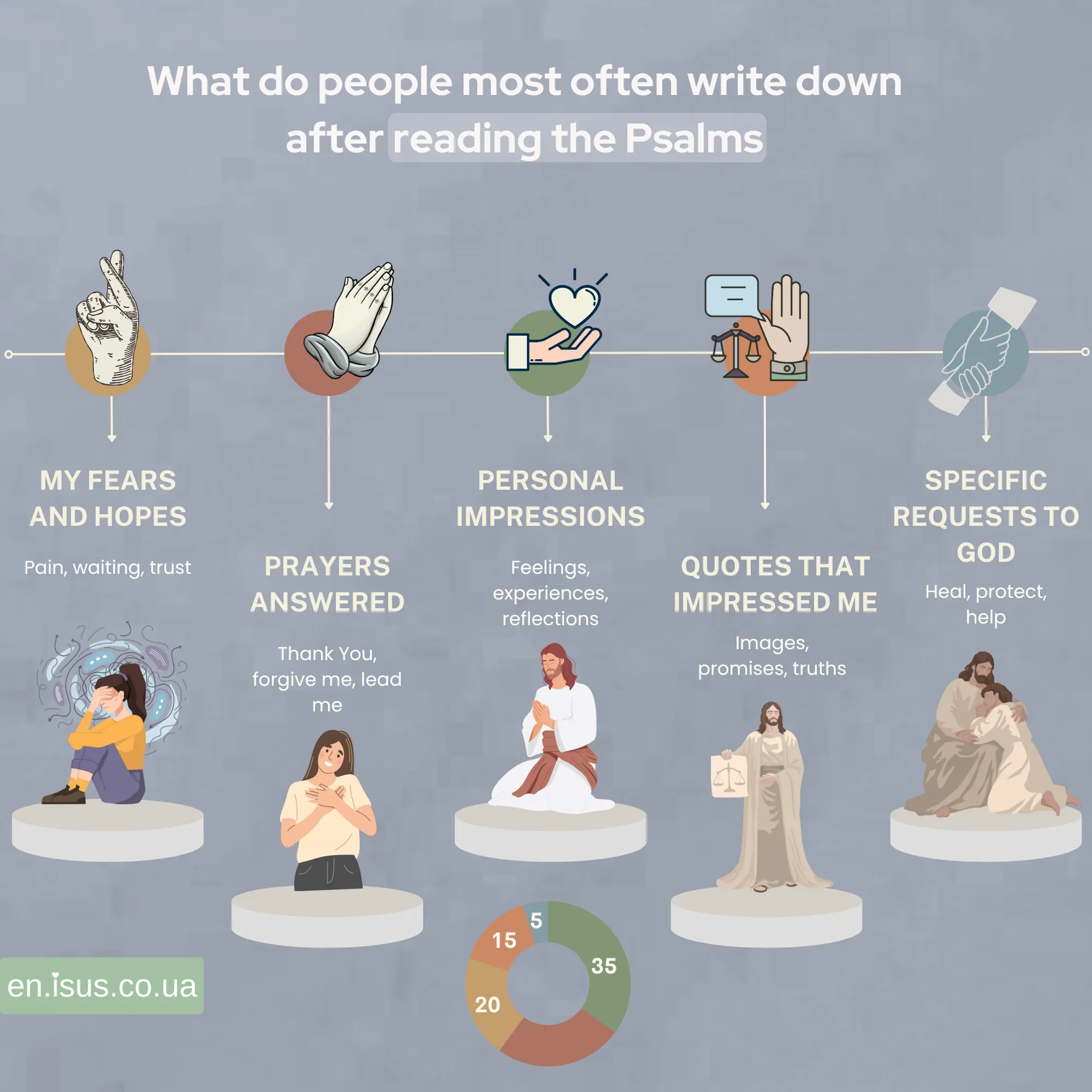
You don’t just want to read the Psalms – you want to experience them.
Keeping a journal helps to anchor what God has touched in your heart.
It can be a regular notebook or notes on your phone.
The key is honesty and openness.
Here’s a simple format that will help you write every day:
| What to write down | How it looks in practice |
|---|---|
| 1. Date and psalm number | May 3 – Psalm 33 |
| 2. A word or line that touched me | “They sought the Lord, and He heard them” |
| 3. What I felt while reading | “My heart was calmed, as if someone embraced me and said: do not be afraid” |
| 4. What this word calls me to do | “To be thankful today, even for the little things” |
| 5. A personal prayer-response | “Lord, teach me to see Your good gifts even in the simple things” |
Write briefly, simply, not by the rules – but from the heart.
Even one sentence is already a conversation with God.
In a few days, weeks, or months, you’ll be able to reread your notes and see how the Lord has gently, faithfully, and gradually worked on your heart.
This will be your personal journey through the Psalms.
The more regularly you do this, the more clearly you hear His voice.
And the warmer your soul begins to glow.
Because God doesn’t speak with force – He speaks with love.
And most often – through the Psalms.
Thematic Table of Psalms
The Psalms are not just prayer texts, but a living library of support, where for every need of the heart there is a healing word.
They help when you are sick, afraid, uncertain, or simply want to thank God.
This table is a tender map for your soul, showing which psalm to open in each life situation.
| Life Need | Psalms That Can Help |
|---|---|
| When you pray for children | 90, 127, 103, 33 |
| When healing is needed | 6, 38, 145, 30 |
| When you want to thank God | 33, 99, 117, 92 |
| When you feel anxious or afraid | 26, 27, 34, 121 |
| When your soul is in pain | 60, 143, 69 |
| When you need spiritual support | 18, 62, 23 |
| When you feel guilty | 50, 32, 38, 102 |
| When asking for wisdom and light | 1, 19, 119 |
| When you are tired or burned out | 61, 42, 63 |
| When you want to bless a new day | 5, 90, 100 |
| When facing a difficult decision | 25, 31, 86 |
| When you need peace before sleep | 4, 91, 121 |
Psalm 84
How lovely are Your dwellings, Lord of Hosts!
My soul longs and yearns for the courts of the Lord;
my heart and my flesh
rejoice in the living God.
Even the sparrow finds a home,
and the swallow a nest for herself,
where she may lay her young –
at Your altar, Lord of Hosts,
my King and my God!
Blessed are those who dwell in Your house –
they will praise You always!
Happy are those whose strength is in You,
whose hearts are set on pilgrimage.
As they pass through the valley of weeping,
it becomes a place of springs,
and the autumn rains also cover it with pools of blessing.
They go from strength to strength –
each one appears before God in Zion.
Lord God of Hosts, hear my prayer,
listen, O God of Jacob!
Look upon us, O God our shield,
gaze on the face of Your anointed one.
For one day in Your courts
is better than a thousand elsewhere.
I would rather stand at the threshold of the house of my God
than dwell in the tents of wickedness.
For the Lord God is a sun and shield;
He gives grace and glory.
No good thing does He withhold
from those who walk uprightly.
Lord of Hosts,
blessed is the one who trusts in You!
In each of these psalms, there is more than just text – they breathe hope.
If you read them slowly, aloud or in a whisper, you will feel the Word begin to speak to your heart.
God speaks gently, yet clearly.
And the psalms are His language of love, which you can listen to at any time.
Read them when you don’t know what to say.
Read them when your heart is silent or when it cries out.
God’s Word is always alive, always timely, always near.
Living Testimonies: How Psalms Change Lives

Psalms are not just ancient texts.
They are prayers that work.
They come alive when read with faith.
When you open the Psalter, you’re not just flipping through pages – you’re touching the heart of God.
And that’s why the Psalms can transform lives – gently, deeply, truly.
“I will bless the Lord at all times; His praise shall continually be in my mouth” – these words from Psalm 34 became a daily source of strength for Natalia, a mother of three.
She began reading the Psalms when her youngest son received a troubling diagnosis.
The doctors spoke cautiously, but her heart was filled with anxiety.
One night, she opened to Psalm 91: “He who dwells in the shelter of the Most High…” – and decided to read it aloud every evening, laying her hands on her child and praying.
A few weeks later, the doctors were surprised: the test results had improved, and the diagnosis was not confirmed.
She didn’t stop praying.
Now the Psalms have become part of her daily rhythm.
She reads Psalm 127 when thinking about her children’s future.
Psalm 34 – when she feels gratitude.
Psalm 4 – when she wants her children to fall asleep peacefully.
Psalm 4
Answer me when I call,
O God of my righteousness.
You have given me relief when I was in distress –
be gracious to me and hear my prayer.
O people, how long will you chase after vanity?
How long will you love what is empty and seek what is false?
Know that the Lord hears the one
who belongs to Him and walks in truth.
If your heart is troubled – do not sin.
Ponder in silence on your bed at night
and trust in the Lord.
Some say, “Who will show us any good?”
But I pray: Let the light of Your face, O Lord,
shine upon us.
You have filled my heart with more joy
than when their grain and wine abound.
In peace I will both lie down and sleep,
for You alone, O Lord,
make me dwell in safety.
Her prayer became simple, sincere: “Lord, I don’t know how it will all turn out, but I entrust my children to You.” And the Psalms became a bridge between fear and peace.
“Your Word is a lamp to my feet” – this is not just a metaphor, but a reality for those who have learned to seek strength not in the news, not in advice, but in the Word of God.
The world changes.
Circumstances unsettle.
But the Psalms remain steady.
For in them is the Spirit of God.
To read the Psalms daily, you don’t need to be a theologian.
You only need to open your heart.
Here are a few simple tips to help:
- Choose one Psalm for the week. Read it every day, either in the morning or before bed
- If you have a specific need, look for a Psalm by topic (see the table below)
- Pray the Psalms – for your children, your loved ones, yourself. Aloud or in silence
- Highlight your favorite lines, write them down on slips of paper, keep them nearby
- Listen to Psalms in audio format – on the road, in the kitchen, while walking
| Need | Recommended Psalms |
|---|---|
| Peace in the heart | Psalm 4, 23, 62 |
| Protection for children | Psalm 91, 127, 33 |
| Thanksgiving | Psalm 33, 117, 99 |
| Before sleep | Psalm 4, 91 |
| Healing | Psalm 6, 38, 103 |
| Spiritual warfare | Psalm 3, 17, 140 |
| When afraid or in trouble | Psalm 26, 143, 60 |
Psalm 3
Lord, how many are those who rise against me,
how many say:
“There is no salvation for him in God.”
But You, Lord, are my Defender.
You are my glory,
the One who lifts my head when it is bowed in sorrow.
I cry out to You, Lord, with my voice,
and You hear me from Your holy heaven.
I lie down and sleep in peace,
and I wake up again, for You are near me.
I will not fear even thousands of enemies
surrounding me on every side.
Rise up, Lord!
Save me, my God!
For You shatter evil
and break the power of lies.
Salvation belongs to You, Lord,
and Your blessing is upon Your people.
Amen.
Psalms are like letters from a loving Father.
They hold everything: tears, songs, silence.
And if today feels hard – just open a psalm.
Read it aloud.
Slowly.
With hope.
And allow God’s Word to speak to your heart with the tenderness you long for.
Living Testimonies: How Psalms Transform Lives
Psalms are not just spiritual poetry.
They are prayers that work.
They act not only in churches or on paper, but in real life, in the heart of a person, in a room where someone cries, in hospitals, in war zones, in a child’s bedroom, in the dark of night.
Psalms are a voice that lifts.
A word that gives hope.
A flame that doesn’t go out.
Below are some true stories that prove: God’s presence in the psalms is alive, gentle, and powerful.
Testimonies: Psalms that Changed a Day, a Month, a Life
“I had never read the Bible until the air raid sirens started,” shares Iryna from Kharkiv. One night I was terrified and opened my phone. I came across Psalm 91. I read it out loud. Then again. And again. All night. It felt like a blanket for my soul. Since then, this psalm is always with me.”
Psalm 91
He who dwells in the shelter of the Most High
finds rest in His embrace.
The Lord is my refuge, my hope,
my God in whom I trust.
He protects me from evil,
from trouble that creeps in secretly.
He covers me like with wings,
and I rest under His shield.
His faithfulness is my protection.
I will not fear the night,
nor the arrow that flies by day,
nor the darkness that hides danger,
nor the plague that destroys at noon.
Thousands may fall around me,
but evil will not touch me.
With my own eyes I will see God’s justice.
For I have made the Lord my Refuge,
and the Most High – my Dwelling.
Therefore no harm will come to me,
nor enter my home.
God sends angels to guard me.
They walk beside me on all my paths.
They lift me in their hands,
so I won’t even stumble on a stone.
I step over evil,
I trample it – and I am not afraid.
Because the Lord is with me.
“Because you love Me –
I will rescue you.
I will protect you, for you know My Name.
You will call upon Me – and I will answer.
I will be with you in trouble.
I will support you, deliver you,
and give you life filled with My light,
life with My Salvation.”
“After surgery I couldn’t speak, says Olena. But Psalm 6 kept repeating in my mind: Lord, do not rebuke me in Your anger. I prayed it silently. Day after day. That’s when I began to feel how close God really is – even when I couldn’t say a single word.”
“I felt like life ended when my husband left, shares Halyna. I was in deep depression. But a friend sent me an audio of Psalm 33. I listened every morning. At first, I didn’t know why. Then – I couldn’t start my day without it. After six months, I could thank God again. Psalms brought my heart back.”
A Mother and God’s Protection Over Her Children
Nataliya is a mother of five.
Every evening in their home ends with prayer.
“We chose Psalm 90 for our evening prayer, she says. At first, we just read it aloud. Then the children memorized lines. We often repeated: You are my refuge, my God in whom I trust. One night, a shell exploded nearby. All the neighbors’ windows shattered – but not ours. And I know: that wasn’t just luck. It was God’s protection. Since then, we take those words even more seriously. Now the kids remind me: “Mom, have we read the psalm yet?”
The Gentle Power of God’s Word in a Person’s Life
There are thousands of such stories.
For some, Psalm 50 became the beginning of deep repentance.
Psalm 50
Have mercy on me, O God,
according to Your great kindness;
in Your boundless compassion
blot out my transgressions.
Wash away all my iniquity,
and cleanse my heart from every sin.
I know my faults,
and my sin is always before me.
Against You only have I sinned
and done what is displeasing to You.
You are right in Your words
and just in Your judgments.
Surely I was sinful from birth,
from the very beginning – prone to evil.
But You desire truth in the depths of my heart
and teach me wisdom within.
Cleanse me, and I will be clean.
Wash me – and I will be whiter than snow.
Let me hear joy and gladness again,
so that the bones You have crushed may rejoice.
Do not look at my sins,
and wipe all guilt from my heart.
Create in me a pure heart, O God,
and renew a faithful spirit deep within me.
Do not cast me from Your presence
and do not take Your Holy Spirit from me.
Restore to me the joy of Your salvation,
and sustain me with a willing and sincere spirit.
Then I will teach transgressors Your ways,
and sinners will turn back to You.
Deliver me from the guilt of bloodshed, O God,
my Savior,
and my tongue will rejoice in Your righteousness.
Open my lips, Lord,
and my mouth will declare Your praise.
For You do not delight in sacrifice –
or I would bring it.
You do not take pleasure in burnt offerings.
The sacrifice You desire is a broken spirit;
a heart that is humble and contrite
You will not reject, O God.
Have mercy on Your people, Lord,
and rebuild the broken walls of Zion.
Then You will be pleased with righteous sacrifice –
a heart, a life, and a loyalty that never ends.
Some people read Psalm 1 every day to remind themselves: do not follow the path of the wicked.
Psalm 1
Blessed is the one
who does not follow the counsel of the wicked,
nor stand in the way of sinners,
nor sit in the seat of mockers,
but delights in the Word of the Lord
and meditates on it day and night with love.
He is like a tree planted by streams of water:
its leaf does not wither,
and whatever he does will prosper.
But the wicked are not so.
They are like chaff that the wind blows away.
Therefore they will not stand in the judgment,
nor belong in the assembly of the righteous.
For the Lord watches over the way of the faithful,
but the way of the wicked will perish.
For some, Psalm 103 became a healing prayer during illness; for others, Psalm 27 strengthened faith in the midst of loss.
Psalms are not theory.
They are a living experience. They are the voice of God’s love.
When you read the psalms, you are truly opening the door to the One who is always near.
And the more you read, the more you realize – it’s not just text, but a touch.
Warm, tender, real.
To help a child’s heart learn to pray not formally, but sincerely, we need to help them fall in love with the Psalter – as one might love a good fairy tale, a warm conversation, or a mother’s lullaby before sleep.
Explain it simply: “The Psalms are a diary of conversations with God. They were written by people who deeply loved God and spoke to Him about everything – when they were afraid, joyful, thankful, or in need of help. They are like prayers from the depths of the heart.”
Children easily sense sincerity.
No need for complicated explanations.
Just read together, pause, explain individual words, and hug them when their eyes light up.
To keep the Psalms from feeling abstract, it’s important to embed them into the child’s real-life experience:
- read a psalm before bedtime, as a peaceful evening prayer
- choose one short verse each week and memorize it together (for example: “The Lord is my Shepherd” or “With You is the fountain of life”)
- create a melody or rhythm and sing a favorite verse like a children’s song;
- invite the child to draw what the psalm describes: God’s castle, a field with sheep, supporting hands, light in the night
- make your own “prayer box” with slips of paper containing psalm verses – each day the child pulls one and reads it aloud
With teenagers, the approach will be slightly different, but just as warm:
- give them the freedom to choose “their” psalm – let them find the one that touches them personally
- connect the reading to life: a psalm during a stressful time, before an exam, or on a joyful day
- listen together to audio psalms in modern Ukrainian translation or with musical accompaniment -there are high-quality versions today with dramatic reading or ambient music
- record your own audio version: let the teen read a psalm aloud and you save their voice as a prayerful keepsake
| Format | Example of Application |
|---|---|
| One line per week | Learn and repeat before bedtime |
| Prayer before sleep | Psalm 4, 91 or 121 |
| Psalm drawing | Illustration for Psalm 23 or 90 |
| Audio psalms | On YouTube, Spotify, or BibleApp in Ukrainian |
| Personal psalm journal | The child writes down or copies what resonates with them |
Psalms are not just prayers for adults.
They are a tender conversation that a child can begin with God from an early age.
And these very words stay with them for a lifetime.
Don’t miss the chance to give your child this light.
Do it with love, in peace, without pressure.
And you will see: a heart that touches the Psalms in childhood will never be empty.
Conclusion
Psalms are not just poetry, not a ritual, not a liturgical fragment.
They are the living language of the soul to God.
They are the voices of those who seek, trust, fall, give thanks, ask, and believe.
The Psalter holds everything: pain and light.
Within it are stories that still speak today.
If you have no words – read a psalm.
If you lack strength – open the Psalter.
If it’s hard – entrust your pain to these verses.
Because Psalms are not just words.
They are love speaking on behalf of the heart.
And they are a prayer that always reaches Heaven.