

Introduction
Everyone, at least once in life, has asked: “Why does God allow suffering?”, “Where is God when it hurts?”, “Why do children, good people, entire nations suffer?”
Table Of Content
- Introduction
- Why does suffering exist? 😩
- How Does God View Human Suffering?
- Why Does God Allow Suffering?
- How Should We Respond to Pain?
- Eternity – God’s Final Answer to Pain
- A Table of Bible Verses for Comfort in Suffering
- A Story of Hope: A Real-Life Example
- Suffering 😒 is not God’s design, but the consequence of evil
- Freedom of Choice and Sin as the Source of Evil
- Human consequences: wars, cruelty, indifference
- God Is Not a Distant Observer: He Suffers With You
- Jesus Experienced Suffering Personally
- God Is Not Against You He Is With You in Suffering
- Suffering is not always punishment
- Why does God sometimes allow pain?
- To stop you and bring you home 🏡
- To grow spiritually and strengthen your heart
- So that you may better understand other people
- That you may see God’s power and glory
- What to do when you are hurting right now
- 1. Don’t hide your feelings – God hears every word
- 2. Pray 🙏 simply and sincerely – without extra words
- 3. Seek support – You don’t have to face this alone
- 4. Don’t Lose Hope – God Has Promised to Be Near Always
- An eternal perspective: our pain is not the end of the story
- God Promises a World Without Suffering
- Eternity Will Explain What Feels Unfair Today
- True Stories of Hope
- Conclusion: Why Does God Allow Suffering? 😔
This is an honest conversation for those who seek answers, who cry, or who simply want to understand.
Why does suffering exist? 😩

Where Did Suffering Come From?
God created the world perfect, full of love and harmony.
But He gave people the freedom to choose – this was His expression of trust 💁 and love.
People chose to follow their own way, turning away from God.
That choice brought suffering – the consequence of wrong human decisions.
Examples of the causes of suffering in the world:
- wars (people choose hatred instead of love)
- hunger (injustice and indifference in societies)
- diseases (ecology, lifestyle, the effects of sin)
- family conflicts (selfishness, pride, resentment)
How Does God View Human Suffering?
Jesus also experienced pain
God is not indifferent to your suffering.
He came into this world in the person of Jesus Christ, who felt pain, loneliness, injustice, and death Himself.
For example, He wept 😢 at the death of His friend Lazarus, felt abandoned in Gethsemane, and was betrayed by His closest disciples.
He knows how you feel when you are in pain.
God is close to those who weep
When you cry, God does not remain distant.
He is near every heart that is broken and hurting.
Psalm 34:18 says, “The Lord is close to the brokenhearted and saves those who are crushed in spirit.”
Why Does God Allow Suffering?
To get a person’s attention
Sometimes God uses pain to stop us from going down the wrong path 🛣️.
An example from the Gospel is the parable of the prodigal son.
It was hunger and suffering that made him return home.
In the same way, God may use hardships to make you reflect and come back to Him.
To teach compassion
People who have gone through hard times often better understand the pain of others.
God allows us to go through certain difficulties to soften our hearts and make us more compassionate toward those around us.
To strengthen character
Suffering builds spiritual strength.
The apostle Paul wrote: “Suffering produces perseverance; perseverance, character; and character, hope” (Romans 5:3-4).
This is not just a beautiful saying – it is a real truth: pain often reveals the true depth of faith.
How Should We Respond to Pain?

Practical Steps in Suffering
- Speak honestly to God about your feelings. He hears every prayerиeven the ones made only of tears
- Don’t isolate yourself. Talk to family, friends, or anyone who can support and listen to you
- Seek answers in the Bible. The Psalms and the Gospels offer true words of comfort for difficult times
- Help others, even when you are in pain. The love you show will return to you as peace ✌️ and consolation.
Eternity – God’s Final Answer to Pain
God promises that suffering will not last forever.
In the final book of the Bible, Revelation 21:4, He says a day will come when He will personally “wipe every tear from their eyes. There will be no more death, or mourning, or crying, or pain.”
Your present pain is temporary, but God’s love for you is eternal.
A Table of Bible Verses for Comfort in Suffering:
| Situation | What the Bible Says |
|---|---|
| Loneliness | “I am with you always” (Matthew 28:20) |
| Loss of loved ones | “Blessed are those who mourn, for they will be comforted” (Matthew 5:4) |
| Despair | “The Lord is close to the brokenhearted” (Psalm 34:18) |
| Uncertainty | “Do not fear, for I am with you” (Isaiah 41:10) |
A Story of Hope: A Real-Life Example
A woman lost her child to a severe illness.
At first, she was overwhelmed with despair and anger.
But over time, she realized that God had not abandoned her, even in that darkest moment.
Her story became an inspiration to many other mothers who faced similar tragedies.
She became a source of strength, comfort, and hope for them.
This example shows that even in the darkest times, God is near and can turn pain into a source of support for others.
God does not promise a life without suffering, but He promises to be with us through the hardest moments.
Suffering is not punishment, but an opportunity to feel His love, to learn compassion, and to discover true spiritual depth.
Whatever your pain may be, God is already near. He loves you, He supports you, and His embrace is always open to your heart.
Suffering 😒 is not God’s design, but the consequence of evil


Freedom of Choice and Sin as the Source of Evil
When God created humans, He gave them a unique gift – the freedom of choice ☑️.
This freedom is a vital condition for true love.
God did not want to create people who would love Him by force or automatically.
Love must be free – and therefore voluntary.
In the Book of Genesis (3:6), there is a story that tells how sin entered the world.
A human made a personal choice, and the consequence of that choice was evil.
God did not create evil – it came into being when people decided to act independently, apart from God.
Just as darkness is the absence of light, evil is the absence of God in a person’s decisions.
Practical insight: when you witness injustice, remember that God is not the author of it. Instead, He is near and ready to help you walk through hard times – if you turn to Him.
Human consequences: wars, cruelty, indifference
Much of the suffering in the world does not come from God’s will.
It is the result of human choices – of people rejecting God’s principles of love and mercy.
Today, we see countless examples of this:
- Wars – God does not start wars; they are driven by human thirst for power, money, or revenge
- Hunger 🤯 – often results from greed and indifference. The world has enough resources, but poor distribution leaves millions starving
- Violence and cruelty – stem from people choosing to live by anger, hatred, or vengeance instead of forgiveness and love
| Consequence of Evil | Cause (Human Decisions) |
|---|---|
| War | Power, greed, revenge |
| Famine | Unequal distribution of resources, selfishness |
| Violence | Anger, hatred, lack of compassion |
How Can You Respond?
- Be mindful of your decisions and intentions. Remember that each of your actions affects others
- Practice compassion 🫂 and mercy, even in small things. It helps reduce the evil around you
- Daily ask God for wisdom and strength to do what is right. He will help you overcome evil with goodness and love
God did not create suffering He created you and the world for goodness and love.
Suffering is a painful result of human mistakes, but even through such circumstances, God lovingly and patiently draws you to Himself.
He is always near, ready to support you and guide you toward the light.
God Is Not a Distant Observer: He Suffers With You
Jesus Experienced Suffering Personally
When you go through pain, Jesus does not remain a distant spectator.
He is the One who personally knows what suffering means.
He walked the path of pain, experienced loneliness, betrayal by close friends, and even death.
Jesus knows what it feels like when those you trust turn away from you, when you are left completely alone in your darkest moments.
Examples of suffering Jesus personally endured:
- Loneliness: In the Garden of Gethsemane, His disciples fell asleep when He needed their support the most (Matthew 26:40)
- Betrayal: Judas, one of the twelve disciples, betrayed Jesus with a kiss (Luke 22:48)
- Pain and humiliation: He endured flogging, beatings, and crucifixion (John 19:1-18)
These facts mean that you can come to Jesus in prayer and speak to Him honestly about what you’re going through.
He understands because He has felt it Himself.
God Is Not Against You He Is With You in Suffering
God is not the one who condemns and punishes in hard times.
He is a tender Father who is especially near when your heart is broken.
The Bible shows how deeply God empathizes with people in their pain.
For example:
- Jesus wept over Jerusalem because His heart ached for those who rejected His love (Luke 19:41)
- He shed tears at the tomb of Lazarus, His friend, even though He knew He would raise him in a moment (John 11:35)
These examples prove that God understands your tears and pain.
He does not distance Himself from you when things are hard.
On the contrary He comes closer.
Here are some practical tips to help you feel His presence in suffering:
- Don’t keep the pain inside. Tell God everything you feel in simple words, like a child speaks to a loving Father
- Find comfort in the Psalms (for example, Psalms 22, 33, 91) and read them regularly
- Recall how God has supported you in the past. Write down these moments to remember how He cared for you
| What to do when it hurts | How exactly to do it |
|---|---|
| Tell God everything honestly | Speak to Him openly, without hiding your feelings |
| Pray simply and sincerely | Use your own words, just as you are |
| Read comforting passages from the Bible | Focus on verses that bring peace and strength |
| Choose Psalms 22, 33, and 91 | Reflect on their meaning slowly and attentively |
| Remember how God supported you in the past | Recall moments of help, comfort, and answered prayers |
| Write down the facts and keep them | Create a journal or list to remind yourself during future trials |
God does not leave you alone with your pain.
He is near, even when you don’t feel it.
He knows your heart, sees your tears, hears your whisper in the night 🌃.
That is why He gently whispers to you through the Bible: “I am with you. Do not be afraid. You are not alone.”
Suffering is not always punishment
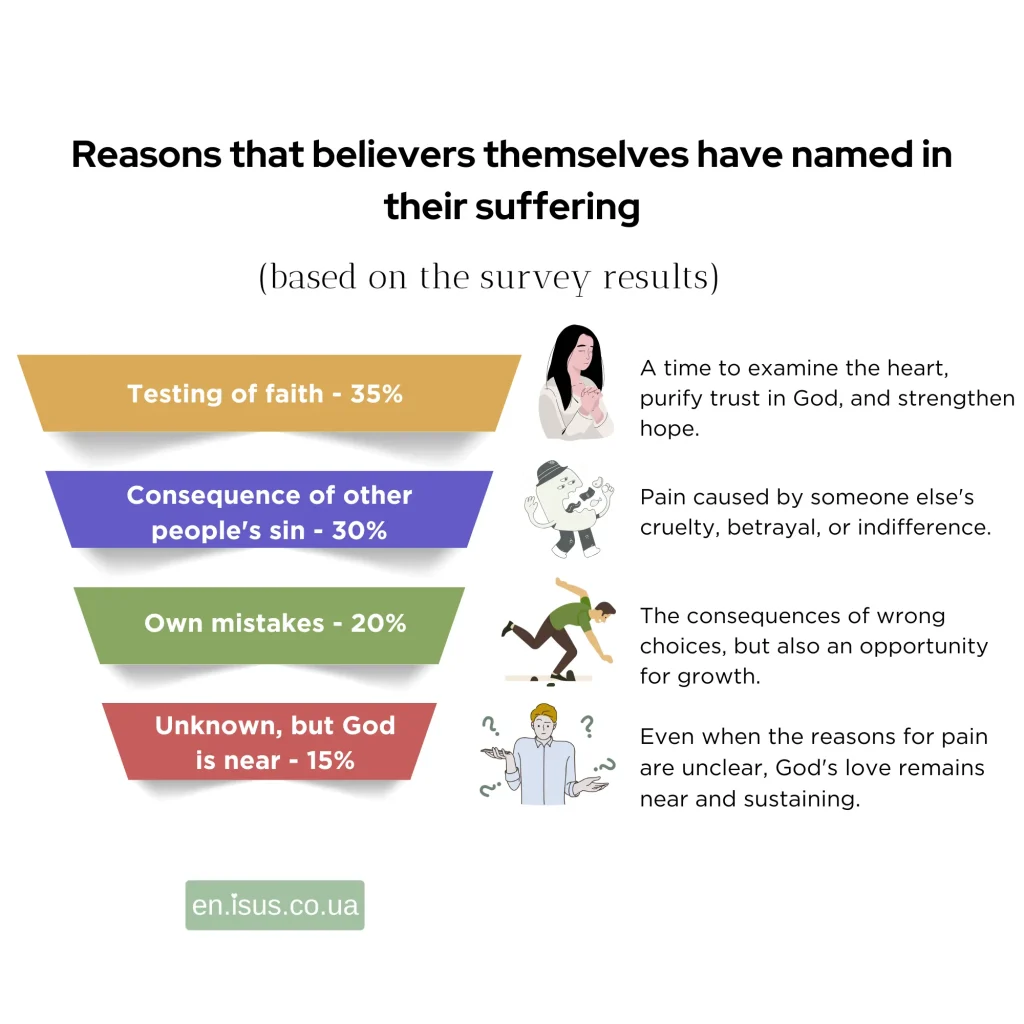
Misconception: “God punishes for something”
Not every pain you experience is a punishment for a bad action.
In the Gospel of John, the disciples asked Jesus about a man born blind: “Rabbi, who sinned, this man or his parents, that he was born blind?” Jesus answered plainly: “Neither this man nor his parents sinned, but this happened so that the works of God might be displayed in him” (John 9:2-3).
This example shows that not all suffering is a result of personal sin.
Another vivid example is the story of righteous Job.
He lived with integrity, was faithful to God, yet suffered great losses and pain without guilt.
Even his friends thought he was being punished, but God showed that his suffering was not caused by sin.
Sometimes suffering cannot be explained by a person’s mistakes or guilt this is important to remember when going through hard times.
God is not a punishing judge, but a Father shaping your heart
It’s crucial to see God not as a strict judge waiting to punish, but as a kind and caring Father.
Like a loving doctor, He may allow temporary pain to bring deep healing.
For example, a child 🧒 might not understand why the doctor gives a painful shot, but the mother gently explains: “It’s to help you get well.”
This is why God sometimes allows suffering – so you can see what you couldn’t see before.
Through hardship and pain, God often teaches patience, compassion for others, and deeper trust in Him.
Practical advice for going through suffering:
- Speak honestly with God. Tell Him directly what you feel – He listens and understands
- Don’t rush to blame yourself. Seek truth in the Bible, not in feelings of guilt
- Ask God to show what He wants to teach you during this difficult time
- Remember the stories of others who went through hardships and became wiser, stronger, and closer to God
Table with simple examples:
| Situation | How a person thinks / How God sees the situation |
|---|---|
| Sickness or job loss | “God is punishing me for my mistakes” → “This is a time for trust and spiritual growth” |
| Family conflicts | “I deserve this punishment” → “I am teaching you patience and forgiveness” |
| Loss of a loved one | “I did something wrong” → “I am near in your tears and pain” |
It’s important to remember: God loves you deeply and tenderly, even when you don’t feel it.
He never leaves you alone in your suffering – He walks through it with you, holding your hand and shaping something precious and unique in your heart.
Why does God sometimes allow pain?
To stop you and bring you home 🏡
Sometimes, God uses pain not to punish but to gently pause your steps and remind you of what truly matters.
Pain can become the voice that softly but firmly turns your attention to eternal values, to God, to your own heart that longs for His warmth.
A vivid example from the Bible: the parable of the prodigal son (Luke 15:11-32).
The son, faced with hardship and hunger, realized through his pain that true happiness awaited him at home – in the loving arms of his father.
Pain became the turning point that changed his life.
What can you do when pain stops you in your tracks?
- Pause and reflect: what is this pain trying to tell you right now?
- Pray simply and briefly: “Lord, help me understand Your voice in this situation.”
- Write down the changes you want to make in your life to find true peace and joy
To grow spiritually and strengthen your heart
Just as iron becomes stronger when heated in fire, your character is shaped through challenges.
The Bible says that suffering produces perseverance, and perseverance builds hope and faith:
“Not only that, but we also glory in tribulations, knowing that tribulation produces perseverance; and perseverance, character; and character, hope” (Romans 5:3-4).
When going through difficulties, remember – God is right there with you, helping your heart become wiser 🦉, deeper, and kinder.
Practical advice for spiritual growth through suffering:
| What to do? | How does it help you? |
|---|---|
| Read the Bible daily for 5-10 minutes | You will gain peace and wisdom for the day |
| Pray in simple words | It will give you a sense of God’s nearness |
| Keep a journal of your experiences | It will help you see how God is guiding you |
So that you may better understand other people
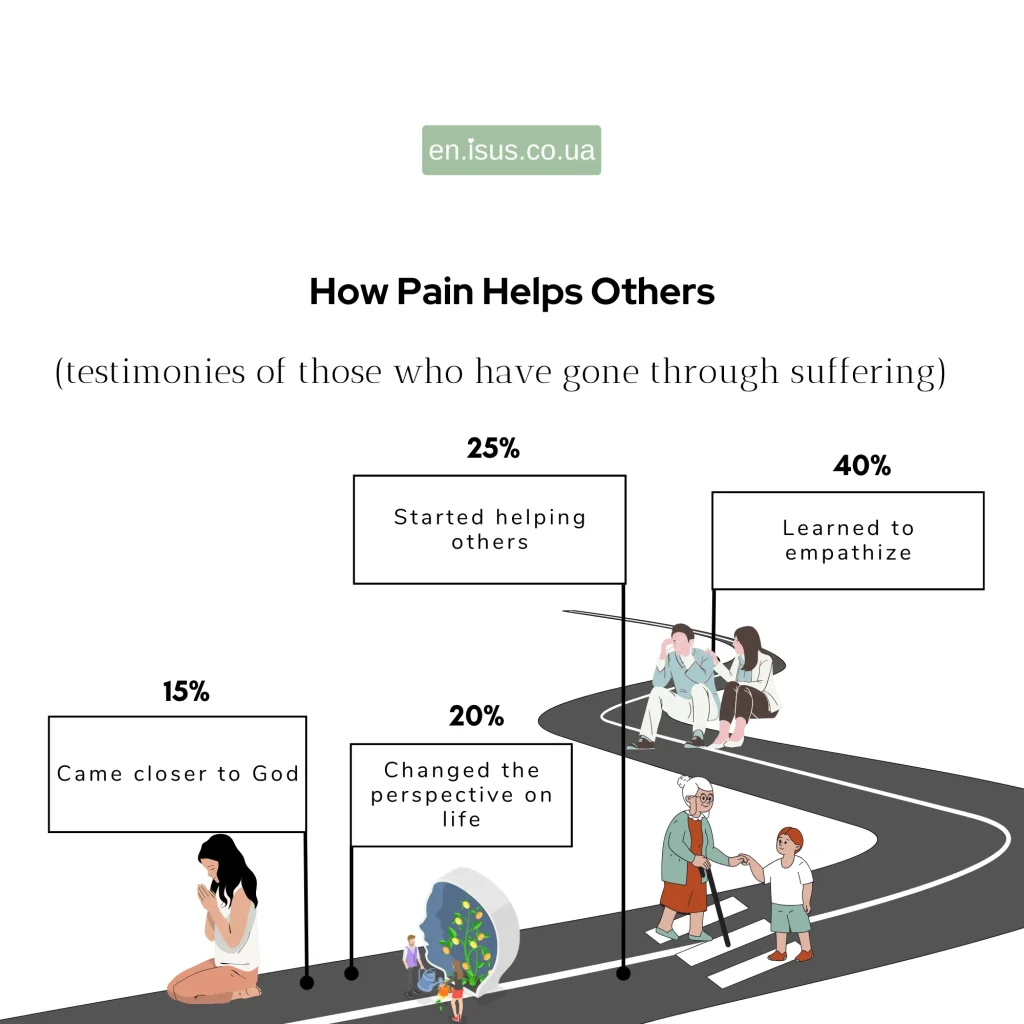
People who have gone through pain become true helpers and friends to those who are suffering now.
They know what tears mean, and that’s why they can offer support with genuine warmth and sincerity.
For example, if you’ve experienced illness or the loss of a loved one, you’ll be able to gently and compassionately support someone going through a similar situation.
How to help others after your own pain:
- Share your story with someone who is facing something similar
- Simply be present when someone is hurting
- Offer practical help: cook a meal, clean the house, or just listen
That you may see God’s power and glory
It is often in the hardest circumstances that you can see how powerful God is and how lovingly He works in your life.
God doesn’t leave you alone – He gives strength that shows up precisely when you feel weak:
“My power is made perfect in weakness” (2 Corinthians 12:9).
When you are weak, God gently takes your hand and does what you could never do on your own.
What you can do to see God’s power:
- Don’t be ashamed to say to God: “I can’t do this on my own, help me.”
- Recall moments when God has already helped you in the past
- Thank Him for being near, even when it’s hard right now
Most importantly, remember: when pain enters your life, God does not turn away.
He walks patiently and tenderly beside you, supports you, and helps you go through any difficulty.
You are His beloved child, and He is always ready to lift you up and lead you forward—with hope and peace in your heart.
What to do when you are hurting right now:
1. Don’t hide your feelings – God hears every word
In painful moments, your emotions can vary: sadness, fear, disappointment.
You don’t have to hide them.
The Book of Psalms in the Bible shows authors who speak openly about pain and exhaustion.
They are not afraid to tell God the truth – even when it is full of tears, doubt, or anger.
God hears and accepts everything that burdens your heart.
He doesn’t reject your words because His love is greater than any sorrow or despair.
How to do this practically:
- Write a letter 💌 to God where you honestly express your feelings
- Read Psalms (for example, Psalm 22, 41, 55), which will help you put your pain into words that God lovingly receives
2. Pray 🙏 simply and sincerely – without extra words


Prayer doesn’t have to be complicated or formal.
True prayer is a simple and honest conversation between your heart and God.
He doesn’t require fancy words – He longs for your sincerity and trust.
Examples of short and simple prayers:
- “God, this is really hard right now. Please help me get through it.”
- “Lord, I don’t understand why this happened, but I believe You’re near. Stay with me.”
- “Jesus, I’m tired. I need Your support. Let me feel Your presence.”
3. Seek support – You don’t have to face this alone
In difficult times, it’s important not to isolate yourself.
God often helps through other people.
He may use friends, family, your church 💒 or a Christian community to bring you comfort, wisdom, and support.
Ways to receive support in practice:
| What to do | Where to find help |
|---|---|
| Share your feelings | Loved ones you trust |
| Ask for prayer | Church, ministry |
| Seek counsel | Pastor, spiritual mentor |
| Join a support group | Home groups, online communities |
4. Don’t Lose Hope – God Has Promised to Be Near Always
Even in the hardest moments, remember: God will not abandon you.
Jesus gave a clear promise in Matthew 28:20: “I am with you always, to the very end of the age.”
No matter how dark the night is, it will end in dawn.
God is near, even when you cannot see Him right away.
How to hold on to hope:
- Write down Bible verses that speak of God’s faithfulness.
- Remind yourself: “God is with me even now. He will not leave me.”
- Read stories of people who went through difficulties and saw God’s support.
Remember: God is not a distant observer.
He is your closest Friend, who not only sees your pain but shares it with you.
You are not alone, because the One who created the stars ✨ sees your tears and gently holds your hand.
He will surely help you walk through these challenges with love, strength, and hope.
An eternal perspective: our pain is not the end of the story

God Promises a World Without Suffering
In Revelation 21:4, God gives a clear and specific promise to every person: “He will wipe away every tear from their eyes, and death shall be no more, neither shall there be mourning, nor crying, nor pain anymore, for the former things have passed away.”
This means that all the pain you are experiencing now is not eternal.
God’s plan is that, in the end, all suffering will disappear forever.
This promise is not only about the future – it is real even now. It gives hope and sustains us in the most difficult moments.
Whenever your pain feels overwhelming, remember: God has not abandoned you. He has prepared a better and brighter future, where He Himself will personally heal your wounds.
Practical advice:
- Write down this promise (Revelation 21:4) and keep it nearby so you can see it every day
- When things get hard, read these words again to remind yourself that suffering is temporary, but God’s love is eternal
Eternity Will Explain What Feels Unfair Today
Today, you may not always understand why you or your loved ones experience pain, loss, or hardship.
The Apostle Paul writes: “For now we see in a mirror dimly, but then face to face. Now I know in part; then I shall know fully, even as I have been fully known” (1 Corinthians 13:12).
This means that full understanding of what is happening in your life will come in eternity, when you meet God face to face.
Your task today is not to find answers to every question, but to trust God even when everything seems unclear.
He knows, sees, and understands far more than you can imagine right now.
Table: What to remember when pain feels unfair
| What You Feel | What God Says About It |
|---|---|
| “I can’t take it anymore” | “I am with you; I will never leave you nor forsake you” (Hebrews 13:5) |
| “This is unfair” | “Vengeance is Mine, I will repay, says the Lord” (Romans 12:19) |
| “I see no way out” | “For I know the plans I have for you… plans to prosper you and not to harm you” (Jer. 29:11) |
Practical steps to help you endure injustice right now:
- Pray simply and honestly: “God, I don’t understand, but I trust You.”
- Don’t stay alone with your pain. Share it with people who love you and will support you in prayer
- Write down at least one moment each day when you saw God’s goodness and support, even in the midst of hardship 🏋
Remember: God’s perspective is greater than your current emotions.
Your pain is not the end of your story – it’s part of the journey. And joy will come.
God is gently holding your hand, leading you toward eternity, where all questions will be answered, and suffering will be forever replaced with joy.
True Stories of Hope
When your heart feels like it can’t bear any more, when the darkness feels too thick, and the path ahead seems impossible, it’s crucial to know: you are not alone.
Thousands have walked through pain, loss, loneliness, illness, and even despair – and it was there, in the heart of suffering, that they met the living God.
Not in theory.
Not in lofty words.
But in real life – in tears, in hospital rooms, at gravesites, in whispered prayers 🧎🏼♂️.
You don’t need to search for light in perfect circumstances.
It appears in the darkest night.
And these testimonies prove it.
Their words are not polished or ideal – but real.
They breathe truth that cannot be faked.
1. Long Years of Treatment, Unbroken Faith
Maria, a mother of three 🧒👶🧒, shared how everything froze after she was diagnosed with cancer.
Plans, dreams, and daily life vanished.
But in that moment, she discovered Jesus’ presence like never before: “When it hurt the most, I simply said, “Lord, hold my hand.” And He did.”
2. Tears in the Kitchen and an Unexpected Song on the Radio
After losing his wife of 25 years, Oleksandr faced unbearable silence and grief.
One day, standing by the window, he heard a song on Christian radio: “You are not alone – I’m near.”
In that moment, he felt not just music 🎶, but an answer.
Not from outside – but from within.
3. Postpartum Depression and a Bible Verse
Iryna, a young mom, spent months overwhelmed by anxiety, tears, and emotional numbness.
One morning, she reached into her coat pocket and found a small piece of paper: a verse she had written before giving birth – “I will never leave you nor forsake you.”
That single line gave her the strength to take the first step toward healing.
4. After Losing His Job – Serving Others
Vasyl lost his job during the war.
At first, it shattered his confidence.
But later he began volunteering at a humanitarian center.
“I realized I could still be useful. That God hadn’t forgotten me. Even without a salary, I found meaning.”
Today, Vasyl coordinates volunteers in his city.
5. A Teen Bullied at School and a Quiet Prayer
Fourteen-year-old Danylo started attending a group where they talked about Jesus.
He was afraid – home and school were both difficult.
But one evening, someone told him, “You are valuable. God sees you.”
Those words became his shield.
Today, he supports younger students who feel rejected.
6. A Chronic Illness and a Joyful Life
Olena lives with multiple sclerosis.
Sometimes, her body won’t cooperate.
But each morning, she reads the Bible and thanks God for a new day.
She says: “I don’t know what tomorrow holds. But I know Who will be with me. And that’s enough to live with hope.”
A practical tip for you: Start a notebook or phone note titled “My Rays of Light.”
Every time you experience even a drop of God’s support – write it down.
Even if it’s just a friend’s words, a surprise “thank you,” a line from a song, or a child’s smile.
These are not coincidences.
They are tender proofs of God’s love.
And when the night falls again 🌑- open that list.
Your story Is still being written.
And it can become something beautiful.
Not because life will be easy.
But because you are not alone.
These stories of hope are not fiction.
They already live in the hearts of those who once thought everything was lost.
And now, they shine in the darkness – for you.
Conclusion: Why Does God Allow Suffering? 😔
The world we live in is filled with pain, wars, sickness, loss, and tears.
But before all of this appeared, God created the world good, harmonious, and full of love.
In God’s original design, there was no place for sin or suffering.
Yet He gave humanity freedom – not as a symbol, but as a real choice.
And this freedom includes not only the ability to love, but also the possibility to do evil.
When the first humans chose distrust over trust in God, sin entered the world.
With it came pain, disease, and injustice.
Suffering is not punishment, not part of God’s plan, and not a sign of His indifference.
It is the consequence of a broken connection with the Creator and the corruption of all creation.
God did not create suffering, but He allowed people to be free – even when that freedom wounds.
It’s important to understand: pain is not always the result of personal sin.
Righteous Job lost everything not because of guilt, but due to a spiritual battle, the meaning of which was revealed only at the end of his story.
The man born blind, whom Jesus healed, was not guilty – his suffering became a field for God’s glory.
Suffering is not always punishment.
Often, it is a space where God speaks most tenderly.
God did not leave humanity alone in its pain.
He entered human history Himself through Jesus Christ, who did not avoid any human experience.
He was betrayed, mocked, He wept, endured, and was killed.
He knows suffering not in theory – but from His own heart.
Jesus did not abandon the world in its darkness, but came into that very darkness to ignite light within it.
And now every tear shed in pain is not a forgotten number to Him – it is kept in His hands.
Sometimes God allows pain to stop, to purify, to deepen, to redirect.
For some, pain is the only way to open their eyes to the meaning of life.
For others, it’s a chance to learn compassion – something that cannot be gained without experiencing sorrow.
Pain can break a person, but with God, it can also become a place of deepest healing.
In suffering, it is important not to remain alone.
Faith does not require silence – God hears sincere words, even when they are just tears.
You have the right to tell Him everything: fear, anger, despair, hopelessness.
He does not turn away – He comes closer.
His response is not always in changing the circumstances, but always in His presence.
Sometimes His silence is not absence, but tenderness waiting for healing to come in time.
To walk through pain, it helps to follow a few simple things:
- Don’t stay silent before God. Pray honestly, in your own words, just as you are
- Connect with a community of believers. Even one faithful friend can change the course of events
- Turn to God’s Word. It is alive and active, especially in dark moments
- Don’t be afraid to ask for help – from a ministry, a counselor, or loved ones
- Trust, even if you don’t understand anything right now. Hope is when you don’t yet see, but already believe
Your pain is not forgotten.
Your prayers are not in vain.
Your tears are not wasted.
God does not cancel suffering – He walks through it with you.
His love 🤍 is not in the absence of pain, but in His presence within it.
When the night is darkest – His heart leans in closest.