

Introduction
Christian poems are the gentle music 🎶 of the soul, flowing from the very heart of heaven.
Table Of Content
- Introduction
- Why Christian poems 📖 remain relevant in today’s world
- Poems as a form of prayer 🙏, learning, and testimony of faith
- The Power of Rhyme: Why Poetry Is Easily Remembered by the Heart
- Who this article is for and why it was written
- The Poetic Heritage of Christianity
- Christian Poetry: From the Psalms of David to Modern Authors
- Poetry in the Christian Home Tradition
- Ukrainian Christian Poets: A Brief Overview of Notable Names
- Christmas Poetry – A Tender Star of Hope
- Christian Christmas Poems for Adults
- The Symbolism of the Manger, the Star, the Shepherds
- Christmas as the Beginning of Humanity’s Salvation
- Examples of powerful 💪 emotional Christmas poems (English rhymed translation)
- How to Use Christmas Poems
- Christmas Poems for Children 👶
- Christmas poems and reflections for children
- Christian Poems for Children: The Joy of Knowing God
- Themes of Beauty and Faith
- How to choose poems for children 👶🧒
- The role of poetry in shaping a child’s spiritual worldview
- Short Christian Poems: Simplicity That Leads to Depth
- Why short poems matter
- Use in social media, cards, notes, and gifts 🎁
- Tips for writing your own short poem
- How to use Christian poems in real life
- Creating Your Own Christian Poetry
- For adults 👱♂️: how to express faith through rhyme
- For children: how to write a poem together
- Advice for parents, educators, and mentors
- How poems can encourage reading the Bible
- How to work with poems in a group or at home
- Advice for Sunday school teachers
- Advice for parents who don’t feel confident as spiritual guides
- Poem collections
- The Best Christian Poems for Christmas ✨
- Poems About Jesus
- Poems About Prayer
- Poems for Thematic Holidays and Clubs
- Conclusion about Christian poems and rhymes
They are like a warm ray of sunshine on a gloomy day 🌤️: they embrace with tender joy, warm with faith, uplift with hope, and fill the heart with love.
Why Christian poems 📖 remain relevant in today’s world
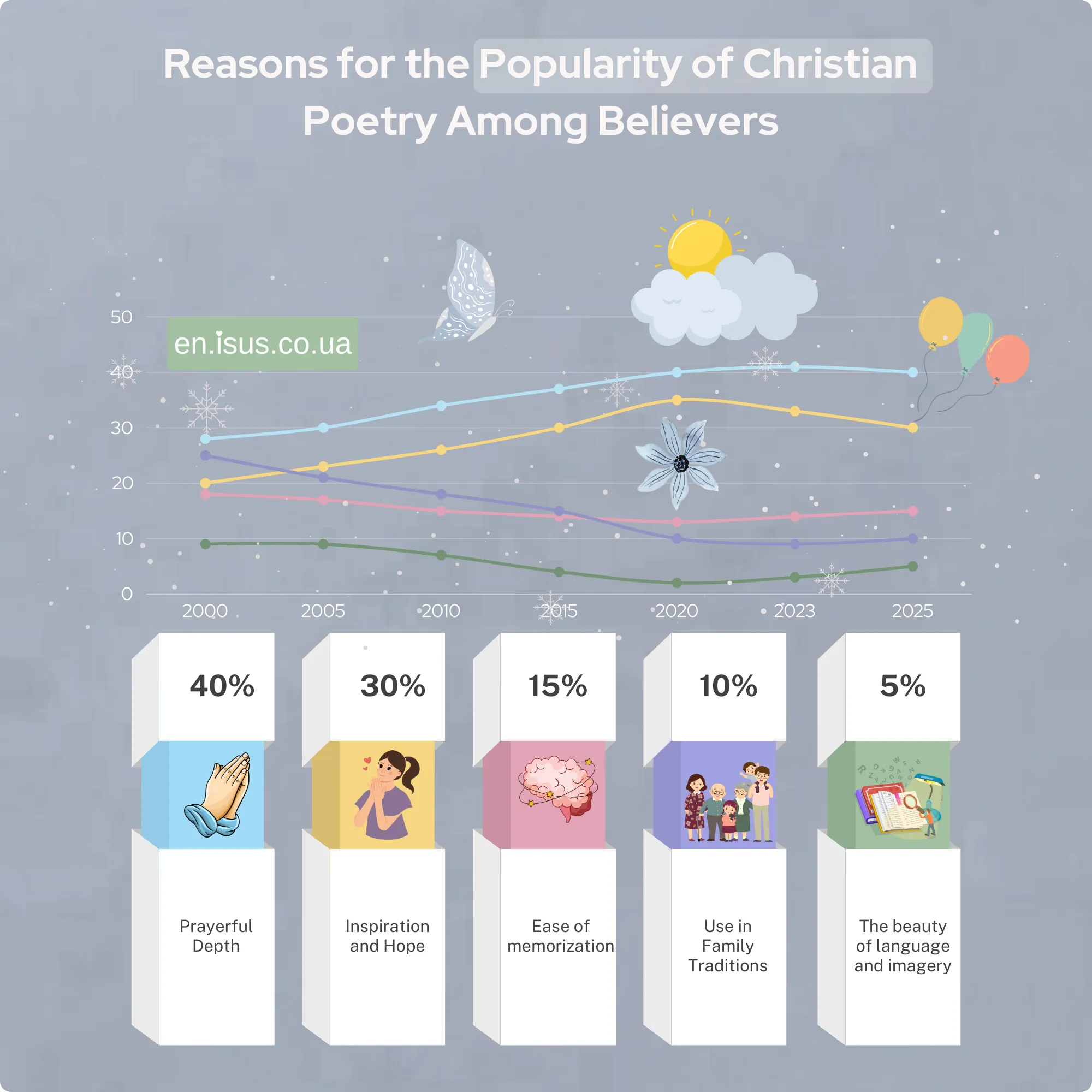
In times of information noise, high speed, and emotional exhaustion, poetic words become a sip of living water 💧.
Christian poems help us focus on what truly matters eternal truths, goodness, love, forgiveness, and faith.
They don’t require much time, yet they can touch the soul in just a few lines.
Poetry is a way to speak 🗣️ simply about what is complex, and deeply about what is profound.
In a world ruled by rationality, it creates space for feelings, compassion, and personal experiences of God’s presence.
Poems as a form of prayer 🙏, learning, and testimony of faith
Christian poetry is more than just artistic expression.
It is a form of communication with God and a way to share truth with others.
It can be:
- Prayer – when the soul speaks to the Creator in verse, offering thanks, requests, or repentance;
- Teaching – especially for children, who easily remember biblical truths, virtues, and stories of the saints through rhyme;
- Testimony – when someone shares their path to God, personal conversion, or the power of divine intervention through poetry.
These are words that can touch the hearts of those who do not yet believe and strengthen those who walk the path of faith.
The Power of Rhyme: Why Poetry Is Easily Remembered by the Heart
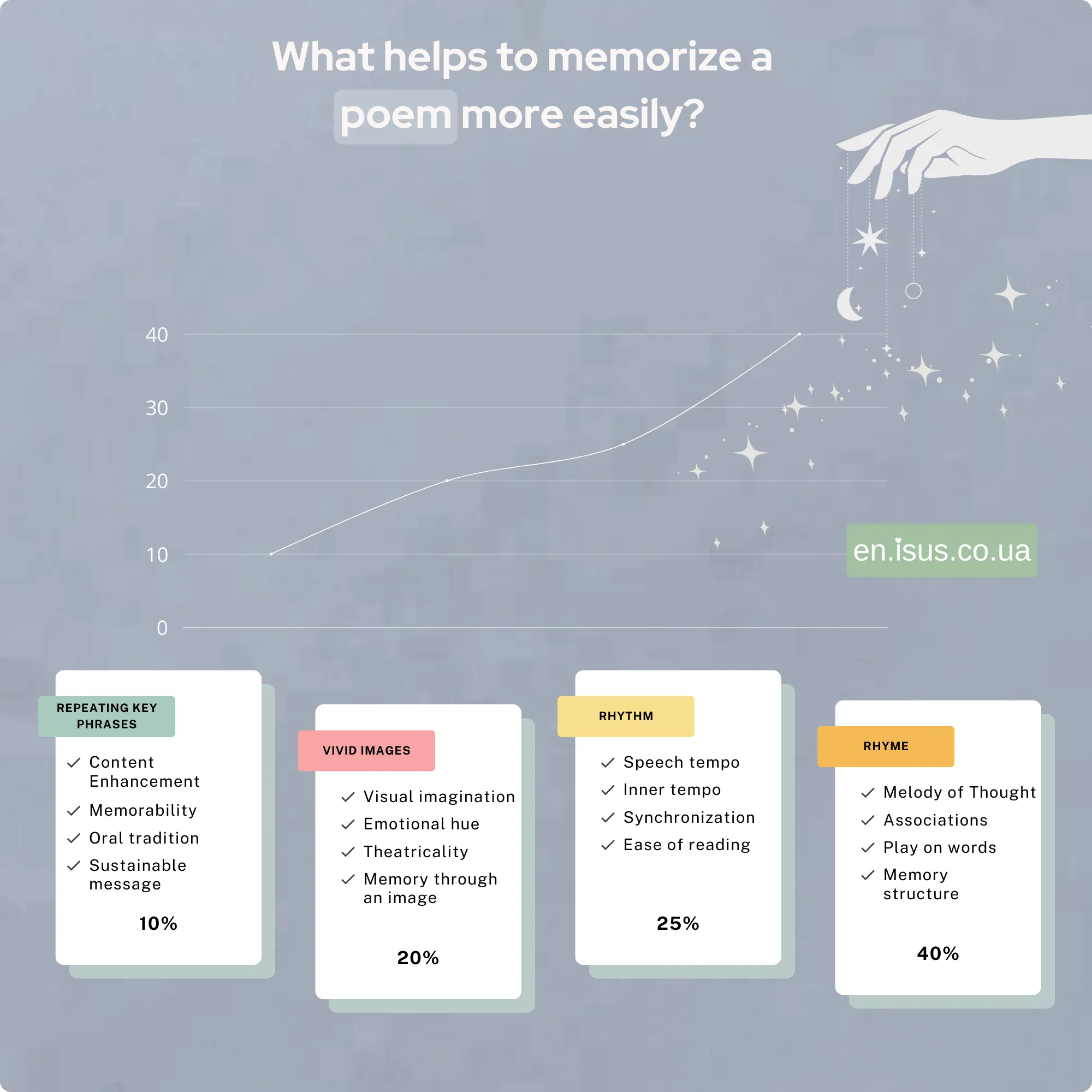
Rhyme and rhythm have a unique ability to structure thought.
Poetry is easier to remember than prose, especially for children.
It activates emotional memory.
Christian poems become inner prayers that accompany a person 🙎 throughout the day, helping them stay focused and keep peace in their heart.
Rhymed words can become part of one’s daily spiritual practice: they can be read aloud, sung, or shared with others.
They have the power not only to be heard but to remain in the heart.
Who this article is for and why it was written
This material is for everyone seeking depth and tenderness in words.
For Sunday school teachers who want to engage children through poetry.
For parents 🧑🧑🧒🧒 who wish to talk about God with their children in a joyful and understandable way.
For young people who want to express their faith creatively.
For anyone in need of words of hope during difficult times.
Here, you’ll find examples of Christian poetry, instructions on how to create your own spiritual verses, and ways to use them in ministry, prayer, and family life.
This article is about the light that can be carried through words – gently, with love, like a lantern 🕯️ in the dark.
The Poetic Heritage of Christianity
Christian Poetry: From the Psalms of David to Modern Authors
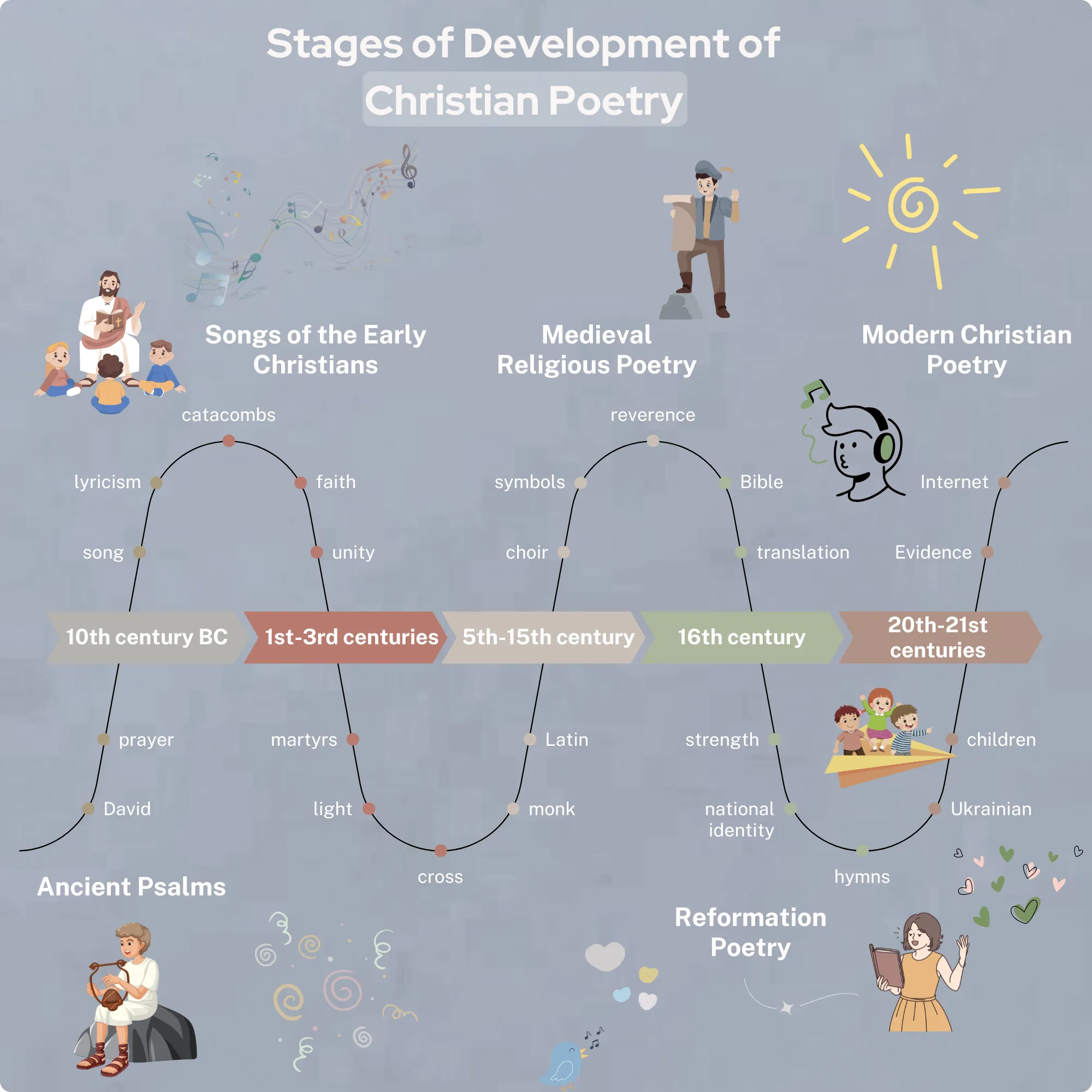
Christian poetry has deep biblical roots.
Even in the Old Testament, you’ll find the Book of Psalms – a collection filled with prayers, songs, rhymed blessings, and spiritual confessions, mostly composed by King David.
The Psalms became a timeless model of poetic prayer.
In the New Testament, we see hymns sung by the first Christians: they glorified Jesus Christ as the Son of God and brought hope and light to persecuted communities.
Over time, Christian poetic expression developed in monasteries, churches ⛪️, and families.
In the Middle Ages, Latin hymns emerged, followed later by spiritual songs in vernacular languages.
In every era, there were those who not only wrote poems – they prayed in rhyme.
Between the 17th and 19th centuries, the number of spiritual songs, psalms, and poems used in worship services and home gatherings grew.
In the 20th century, Christian poetry became more emotionally personal, and in the 21st, it became accessible through books, websites, blogs, and even social media.
Christian poets never wrote for themselves alone – their verses were always a gift for others.
Through them, the Lord touches hearts, brings comfort, lifts up souls, and teaches.
And everyone who reads or listens to such a poem becomes a partaker of divine grace.
Poetry in the Christian Home Tradition
In Christian home traditions, poetry is used for the spiritual upbringing of children 🧒👶, for festive performances at Christmas and Easter.
These poems often take the form of prayers, thanksgiving, supplication, or testimony of God’s mercy.
Such a poem may be handwritten in a journal or recited at the family table among loved ones.
A good Christian poem becomes part of everyday life: it is memorized, quoted in letters, added to videos, cards, stickers, and greeting notes.
Poetic language breathes life into God’s Word in the heart, making it closer, warmer, and easier to understand.
Ukrainian Christian Poets: A Brief Overview of Notable Names
Ukraine has a rich tradition of spiritual poetry.
Among the most renowned authors:
- Taras Shevchenko – His works reflect a deep Christian faith, sorrow for his people, and a dream of God’s truth on earth.
- Hryhorii Skovoroda – A philosopher and poet who praised spiritual freedom and life in Christ.
- Natalia Lototska – A contemporary writer of profound spiritual poetry, especially for children.
- Vasyl Stus – Though often secular in theme, his poetry is filled with biblical allusions and inner Christian struggle.
- Lina Kostenko – Her work contains deep reflections on spirit, light, faith, and mercy.
Beyond these famous authors, countless lesser-known Christian poets share their verses within communities, blogs, and collections.
Though their names may be unknown to the wider public, their words touch the soul.
These poems are often written by mothers, teachers, grandmothers 👵🏻, and Christian educators with love, for their children, their communities, and their Church.
The value of a Christian poem lies not in the fame of the author but in its sincerity, faithfulness to God’s Word, and the light it brings.
You too can take part in this great legacy by reading, teaching, writing, and sharing poetry that leads hearts to Jesus.
Christmas Poetry – A Tender Star of Hope
Christian Christmas Poems for Adults
Christian Christmas poetry for adults is more than just rhymed lines – it is a touch to the heart ❤️, a gentle reminder of the greatest miracle in human history: the birth of Jesus Christ.
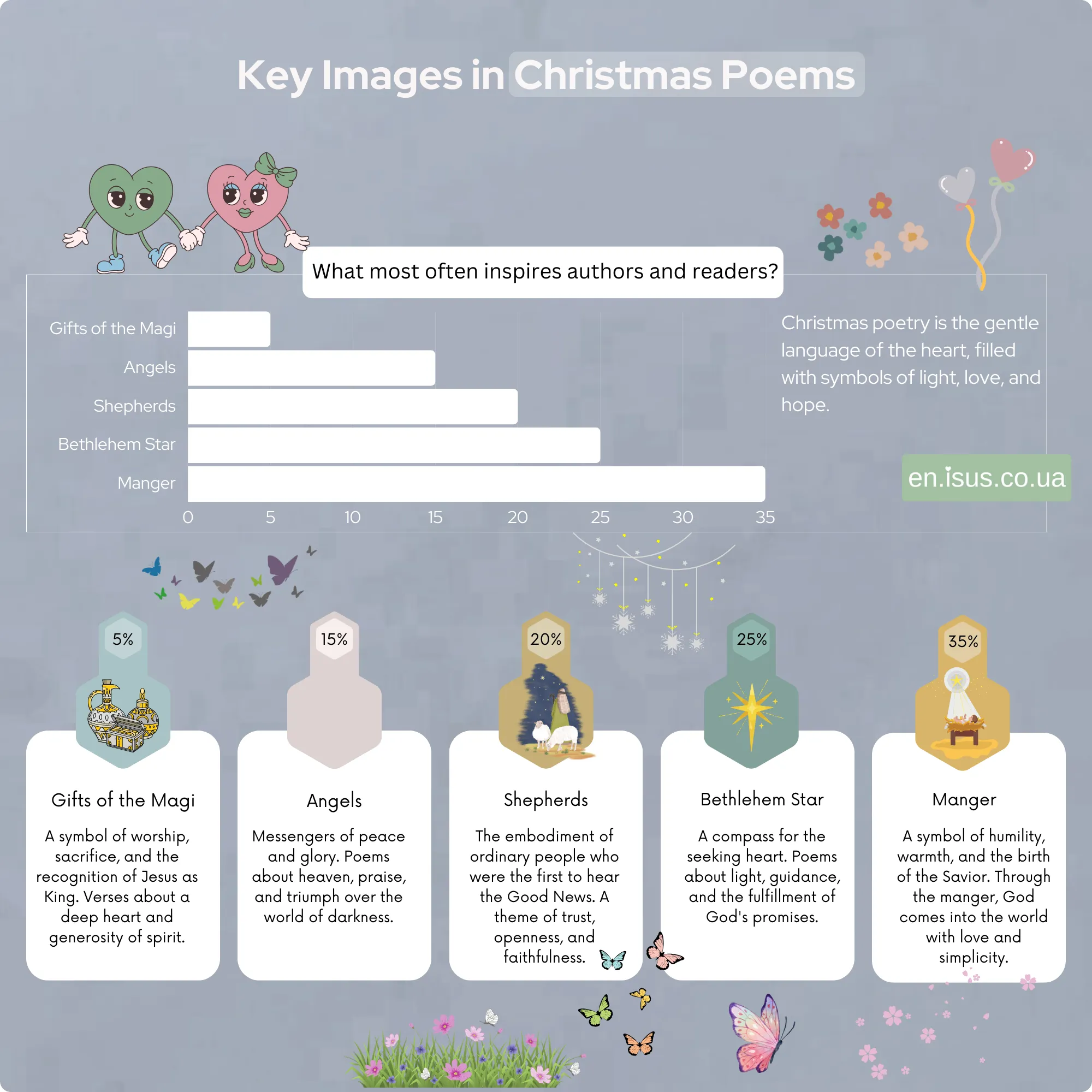
Through images of the manger, the star, the shepherds, and Mary bowed in quiet awe, poetic words speak of God’s love for humanity.
They awaken the memory of the true meaning of Christmas – not only the warmth of family, but above all, the gift of Salvation that came into the world in the form of a Child.
The Theme of the Savior’s Birth
At the heart of every poem is Christ.
His birth is not merely an event – it is the beginning of hope for each soul.
It is poetry of light that shines through the darkness, forgiveness that enters the world through a Child, peace that descends gently upon hearts.
The Symbolism of the Manger, the Star, the Shepherds
The manger is a symbol of humility and simplicity, where the King of kings was born.
The star ✨ is a sign of divine providence, leading the way to truth.
The shepherds – ordinary people who were the first to receive the good news – show us that God speaks to those who listen with their hearts.
All these images are a treasured part of the Christmas poetic tradition.
Their presence in verse adds meaning that moves and enlightens.
Christmas as the Beginning of Humanity’s Salvation
It is important that poetry emphasizes: Christmas is not the end – it is the beginning.
Christ was born to give Himself for us.
Through poetry, we can gently yet clearly express the truth: God’s love was not confined to heaven – it came down to us.
Poetry allows the soul to experience this personally.
Examples of powerful 💪 emotional Christmas poems (English rhymed translation)
1. “In the Silent Night”
In the silent night, where shadows lay,
Hope was born in a humble way.
No throne, no light, no golden flame
The Heav’nly Son in a manger came.
A star now burns like a living heart,
God’s new salvation is about to start.
Shepherds kneel, and wise men see
The One who will cleanse the world lies peacefully.
2. “The Savior Was Born”
The Savior was born not in halls of gold,
But in a stable, quiet and cold.
He sought no power, claimed no name,
Just hearts that longed for love, not fame.
The world knew Him not, turned away in the night,
But love like the Father’s hand held tight.
He came for all both strong and small,
The righteous, the lost, the forgotten, the fall.
3. “Star of Light”
A star of light lit up the sky,
And carved a path from earth to high.
God did not leave us in shadows and tears
He came to serve and calm our fears.
Not with sword, nor thunder loud,
But in a touch both soft and proud.
Receive Him now like children near
And Christmas will echo all days of the year.
All the poems from this article may be used in social media, printed materials, Sunday schools, videos, and website publications, with credit to en.isus.co.ua.
How to Use Christmas Poems
- In Church Services
Poems can be read by congregants after the sermon or before prayer. They sound especially moving when performed by children or youth. They can be woven into nativity plays or the overall Christmas service program. - In Family Gatherings
Christmas Eve is a wonderful time to set aside screens and read a few poems together. It can become a family tradition that unites generations. Light a candle, play soft music 🎧, and let poetry speak. - In Blogs, Social Media, and Videos 📹
A strong Christian poem is the perfect companion for a Christmas post on social media. It can be designed as a quote with a beautiful image, recorded as an audio reading, or turned into a video for YouTube or Reels. - In Printed Materials
Poems can be included in greeting cards, bookmarks for Bibles, or children’s booklets. Rhymed words are easy to remember and leave a mark on the soul. - In Creative Clubs and Lessons
Poems are wonderful for working with children not only memorization, but also discussion, dramatization, illustration, and writing their own verses. This deeply shapes spiritual thinking.
A tip: save your collections of Christmas poems in separate folders for kids, adults, short pieces, and thematic ones. Over time, you’ll build a priceless treasury to share or return to each year with fresh meaning.
A Christian poem is a thread of light to the heart.
Through it, God speaks gently, tenderly, without force.
Let poetry speak to your soul and pass love onward.
Let Christmas be not only a celebration of tradition, but a celebration of God’s real presence through word, rhyme, compassion, mercy, and warmth.
Christmas Poems for Children 👶
Simple, radiant, and imaginative Christmas poems have great educational and spiritual value.
They not only add beauty to holiday programs, but also open a child’s heart to the tender truth: God became Man.
Christmas poetry helps explain the deep meaning of the holiday through accessible imagery, warm language, and sincere love.
Main themes for Christian Christmas poems for children:
- the birth of baby Jesus in Bethlehem
- the holy Joseph and Mary
- the angels in heaven announcing joy
- the shepherds who hurried to the manger
- the star that guided the wise men
- the warm atmosphere of the nativity
- goodness, sincerity, prayer
The role of poems at Christmas:
- in performances at preschools and schools
- during afterschool programs and clubs
- in Sunday school lessons
- for reading in the family circle before an icon or Christmas tree
- as texts for holiday cards or gifts
Ideas for interactive poetry activities:
- Action poems – children act out angels, shepherds, and bowing to baby Jesus as they recite.
- Coloring poem – after reading, children color an illustration related to the theme (e.g., manger, angel, star).
- Poem quiz – questions like: who came to Jesus? what did the angels sing?
- Musical enhancement – add a melody or simple background sound (bells, harp).
- Create your own poem – children come up with rhymes or complete lines.
Christmas poems and reflections for children:
1. “An Angel Glides Through the Night”
An angel softly soars through night,
A star above shines clear and bright.
Through snow and stillness, leads the way
To where our Jesus sleeps in hay.
2. “Heaven’s Grace in the Manger”
A Child in silence rests so near,
The starlight whispers: Love is here.
In tender straw, like clouds above,
Sleeps Heaven’s Gift, the King of Love.
3. “Mary Whispers Her Lullaby”
Saint Joseph warms Him with his care,
While Mary whispers soft in prayer.
No fear or darkness lingers there
Just peace, and joy, and love to spare.
4. “The Shepherds Bring Their Gifts 🎁”
The shepherds cheerful, filled with cheer,
Bring humble gifts from hearts sincere:
Some cheese 🧀, some bread 🍞, a jar of honey 🏺
All given freely, not for money.
5. “A Heart That Carries Light”
A heart as gentle as the dawn,
Embraces light, and night is gone.
For Christ has come to make things right,
And fill each soul with blooming light.
6. “Light Has Come With Love”
Where faith is found, there wings will grow 🪽,
Where mercy dwells, true strength will flow.
In every dream, in every word,
His hope and light are gently stirred.
Thoughts for parents and teachers:
Choose poems with warmth and clear, kind meaning.
Repeat the same poem for several days – children remember through rhythm and repetition.
Invite them to draw what they imagine as they listen.
Talk together about the heart of it all: What might baby Jesus have felt? Why did He come in such a gentle way?
A children’s poem is not just rhyme.
It is a seed of love for Jesus, a way to teach kindness and truth, a path to shape the heart 💚.
Christmas verses are little keys that unlock faith, and open a child’s soul to heaven’s light.
The more love you plant in a word, the deeper it takes root.
Christian Poems for Children: The Joy of Knowing God
Christian poems for children are a gentle key to discovering God’s love.
Through simple, vivid lines, a child learns to believe, to hope, to love, to listen to their heart, to understand goodness.
It’s not just rhyme – it’s the seeds of faith growing in the soul.
They can be read at bedtime, learned in a Bible group, recited at celebrations, or simply reflected upon in silence.
It’s important to choose poems not only by age, but by the themes that resonate with your child.
Themes of Beauty and Faith
About Jesus
These poems help children know the Savior as a Friend, Protector, and Teacher.
They open the heart to a personal relationship with Him.
They are wonderful to read before sleep or in Sunday school.
Example:
“Gentle Jesus, my shining ray,
Leads me by hand through every day.
When I am crying, He stays so near,
And hugs my heart in quiet cheer.”
About Prayer 🙏
They teach children simple ways to speak to God.
It is sincere gratitude, requests, and the joy of communion with the Father.
Such poems can be used as a morning or evening prayer.
Example:
“God, I thank You every day
For my mom and dad, I pray.
For flowers, sunshine up above,
For peace and joy, and family love.”
About the Bible
They explain to children why reading God’s Word is important.
These poems can inspire the first verse read, a story discovered, or even a playful moment.
Example:
“The Bible is big, it’s living and bright,
God’s words of peace and truth and light.
When I feel sad, I open its pages
And hope comes flying through its stages.”
About kindness, love, and obedience
They shape moral values through kind examples, Bible stories, and daily situations familiar to children.
They are perfect for everyday reading at home or in class.
Example:
“If I forgive and kindly share,
Jesus will smile with tender care.
For love is more than what we say
It’s doing good things every day.”
About family, parents, and friendship 🤼♂️
They help children understand the value of family, to give thanks, to respect loved ones, and to be sincere in friendship.
These are poems that even touch the hearts of grown-ups.
Example:
“Mom is a light that shines in my soul,
Dad is the sky so calm, so whole.
Brother’s like wind, joyful and free,
Sister a flower 🌸 in God’s care for me.
Family’s a heart that warms us each day,
A home with prayer and bread on a tray.
And friendship’s a hand that walks by your side,
In both the laughter and tear-filled tide.”
About Creation (nature 🌱, animals 🐏, light ☀️, sky ☁️)
They awaken wonder and gratitude for all the beauty around.
Through these poems, a child learns to see God in every flower, drop, and bird 🐥.
Example of a poem:
“The sun in the sky is God’s hand,
Giving love without end.
And the wind – the whisper of His kindness,
Caressing cheeks and swaying trees.”
About Great Christian Holidays
They help a child understand the depth and joy of celebrations like Christmas, Easter, and the Annunciation.
Perfect for festive performances, greeting cards, or family reading time.
“A Baby sleeps in manger-bed – our Jesus pure and small,
Above, a star glows overhead, and angels sing to all.
The world with joy receives its King, in song and candlelight,
May every heart His warmth now bring, and shine with holy light.”
Christian poems for children are more than rhymes.
They are a path to the heart.
Write them down 📝 in notebooks, recite them at celebrations, tuck them into cards, create little books with illustrations.
These lines don’t just teach – they turn childhood into rich soil for faith, peace, and love.
How to choose poems for children 👶🧒
By age
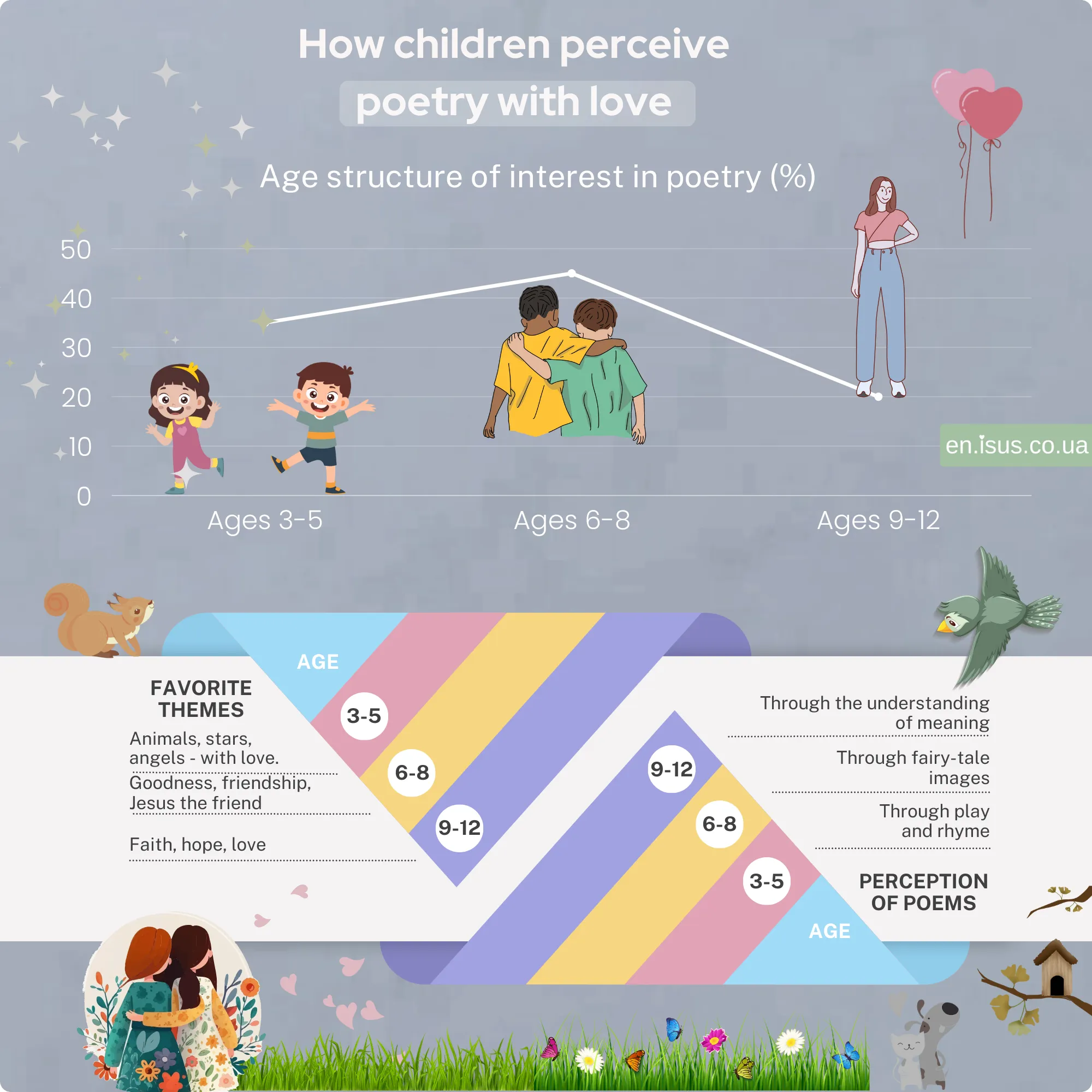
The choice of poems depends on the child’s developmental stage.
For preschoolers, short texts with clear rhythm and repetition are best.
Images should be simple and familiar: light, sun, mother, angel.
Younger school-age children can already grasp meaningful poems with a moral message.
They enjoy stories, dialogues, and creative comparisons.
Teenagers seek depth, they ask about the meaning of life, suffering, justice, and love.
For them, sincerity, relevance, and poetic strength matter.
By purpose
Poems can serve many purposes.
• To teach – introducing God, prayer, and biblical truths
• To inspire – offering support in difficult moments, awakening faith
• To amuse – through humor, childhood stories, and playful rhymes
• To calm – perfect for bedtime or peaceful evening reading
By form
• Rhymed prayers are easy to remember and become part of daily spiritual life
• Riddles develop thinking and curiosity about biblical themes
• Dramatizations are great for groups and holidays: poems can be recited in parts, with movements or scenes
The role of poetry in shaping a child’s spiritual worldview
A Christian poem can gently and powerfully convey values through the heart, not instruction.
Rhyme itself helps a child remember the truth more easily.
How a poem teaches faith, love, and forgiveness:
• When a child hears that Jesus forgives, they learn to forgive others
• When they read that God loves them, they accept themselves and begin to bloom
• When they see an example of goodness in a poem, they long to do the same
Examples of use in different settings
Family reading
Choose 1-2 poems in the evening brief, sincere, with a simple explanation.
Accompany reading with conversation or drawing.
Create a personal notebook of the child’s favorite verses.
Group learning
Use poems as an introduction to a lesson, as the main content (for analysis, recitation, dramatization), or as a creative task to compose their own poem.
Add interactive elements who finds the rhyme first, who illustrates the poem 🖼️, who creates a continuation.
Ministry
Poems can be shared during children’s services, festive presentations, or dramatizations.
Always include an explanation of the biblical truths conveyed by the text.
Children believe in words when they see that you live by them.
Examples of poems for children
For preschoolers
“In the morning the angel spread his wings,
Sunlight in his hands sparkles and sings.
He says: “Jesus is near, you’re never alone
His love surrounds you from heaven’s throne.”
For young school-aged children
“There’s a book in heaven bright Bible so true,
It tells of God’s love, simple and new.
It teaches us live kindly and bright,
Forgive like Jesus, and shine your light.”
For teens
“When it’s dark around me or winds push hard,
I know with God I don’t fear the dark.
Jesus my Savior, my daily fire,
I follow Him truly, with faith that inspires.”
In poems, the most important thing is not perfect rhyme, but the sincerity of the heart.
Don’t be afraid to write your own lines even if it’s just two.
What matters most is the love and faith you place inside.
That’s what the child will remember forever.
Short Christian Poems: Simplicity That Leads to Depth
Why short poems matter
A short poem is like a beam of light in the rush of daily life.
It’s easy to remember, stirs the soul, and offers encouragement.
Small verses are like prayerful grains you can carry with you throughout the day.
They quickly reach the heart especially when speaking to children or when you simply want to remind someone of God’s love in a gentle, sincere way.
These poems are fitting in many situations:
- when you lack time but long for a spiritual word
- for young children who aren’t ready for longer texts
- as a reminder on your desk, notebook, or mobile phone 📱
- for gift tags, card inscriptions, or notes in letters
- for social media, where brevity and sincerity matter
Use in social media, cards, notes, and gifts 🎁
Short Christian poems are perfect for:
- Instagram captions, stories, and reels
- greeting cards for Christmas, Easter, birthdays
- tiny notes inside gift packages
- decorating bulletin boards in schools, kindergartens, or Sunday classrooms
- creating illustrated prints or coloring pages with verses
- offering spiritual comfort through a message or a letter
Examples of 2-4 line poems
“God’s mercy shines from up above,
Jesus is the tale my heart will always love.”
“God holds me gently in His hand,
Even through tears I don’t understand.”
“When fear comes near I pray instead,
I know that Jesus walks ahead.”
“In heaven’s light and earth below,
God guides my steps in good I sow.”
“I greet each day with joy and grace,
For I lift praises to Jesus’ face.”
“Morning comes, an angel near,
Whispers, “Give your worries to Jesus, dear.”
“The sun above is God’s sweet sign,
That mercy in the heart will shine.”
“The cross a bridge from pain to peace,
Hold tight to faith and don’t release.”
“In the quietest of days,
God speaks in wordless, loving ways.”
Tips for writing your own short poem
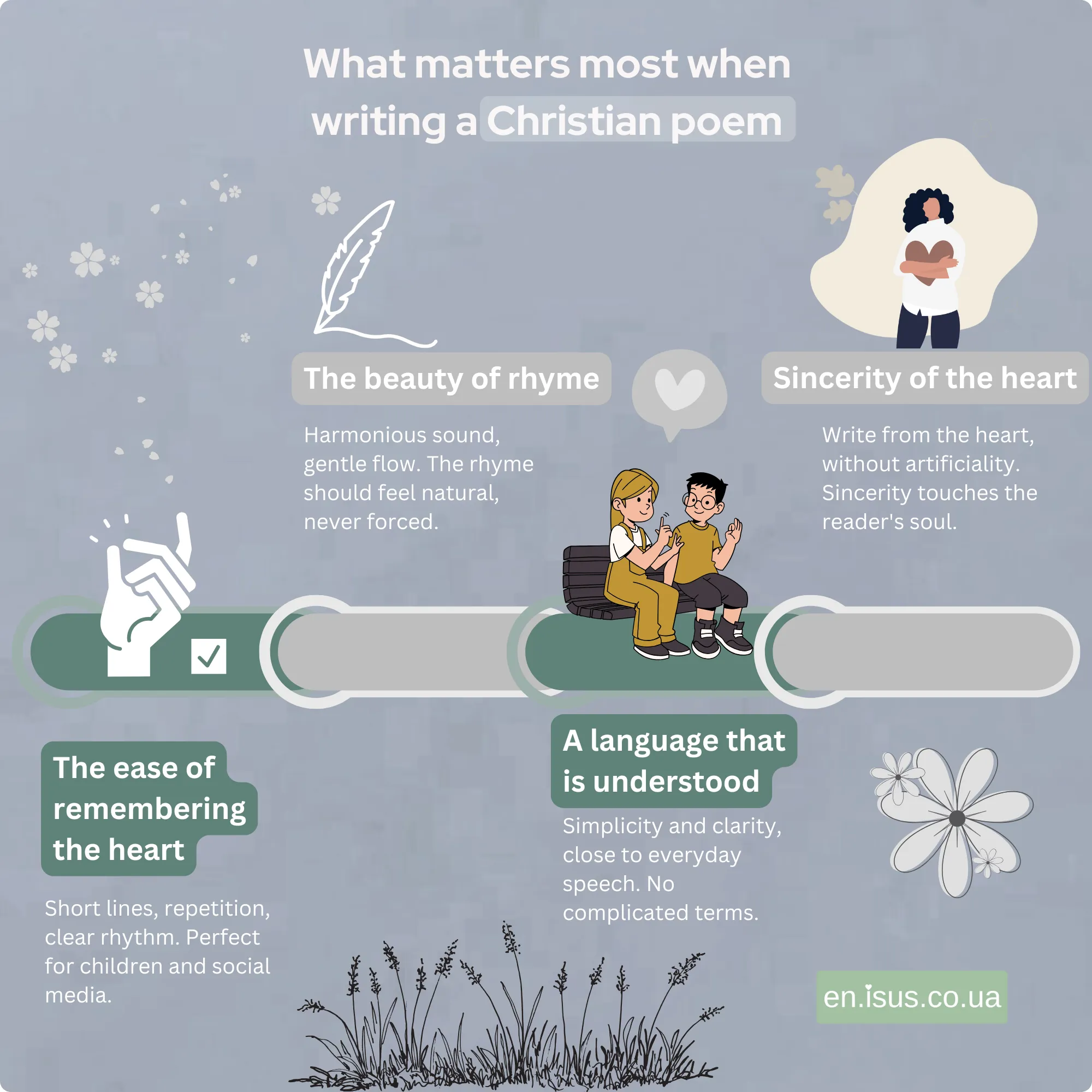
- Choose one thought or emotion. Don’t try to say everything at once. A short poem is about one truth, one feeling, one moment.
- Write the way you speak. Simplicity is the key 🗝️. Avoid complicated language or artificial words.
- Let there be music. Read it out loud. If the rhythm feels right to your ear, you’re on the right path.
- The heart of Scripture. You don’t have to quote the Bible, but the meaning should align with the Gospel.
- Be inspired by the moment. Look at the sky, listen to a bird singing 🐤, remember your childhood and write something divine from that.
- Don’t be afraid of emotion. A good poem always reveals a little bit of the soul. That’s not weakness it’s strength.
- Practice is the best teacher. Write ten versions of the same poem and you’ll be surprised how each one gets better.
You can create a personal collection of short poems for different moments: joy, comfort, sorrow, gratitude, prayer, inspiration.
They don’t take much time, but they can change a day yours or someone else’s.
Write with love. Share the light ☀️.
Your lines may become someone’s answer to prayer.
How to use Christian poems in real life
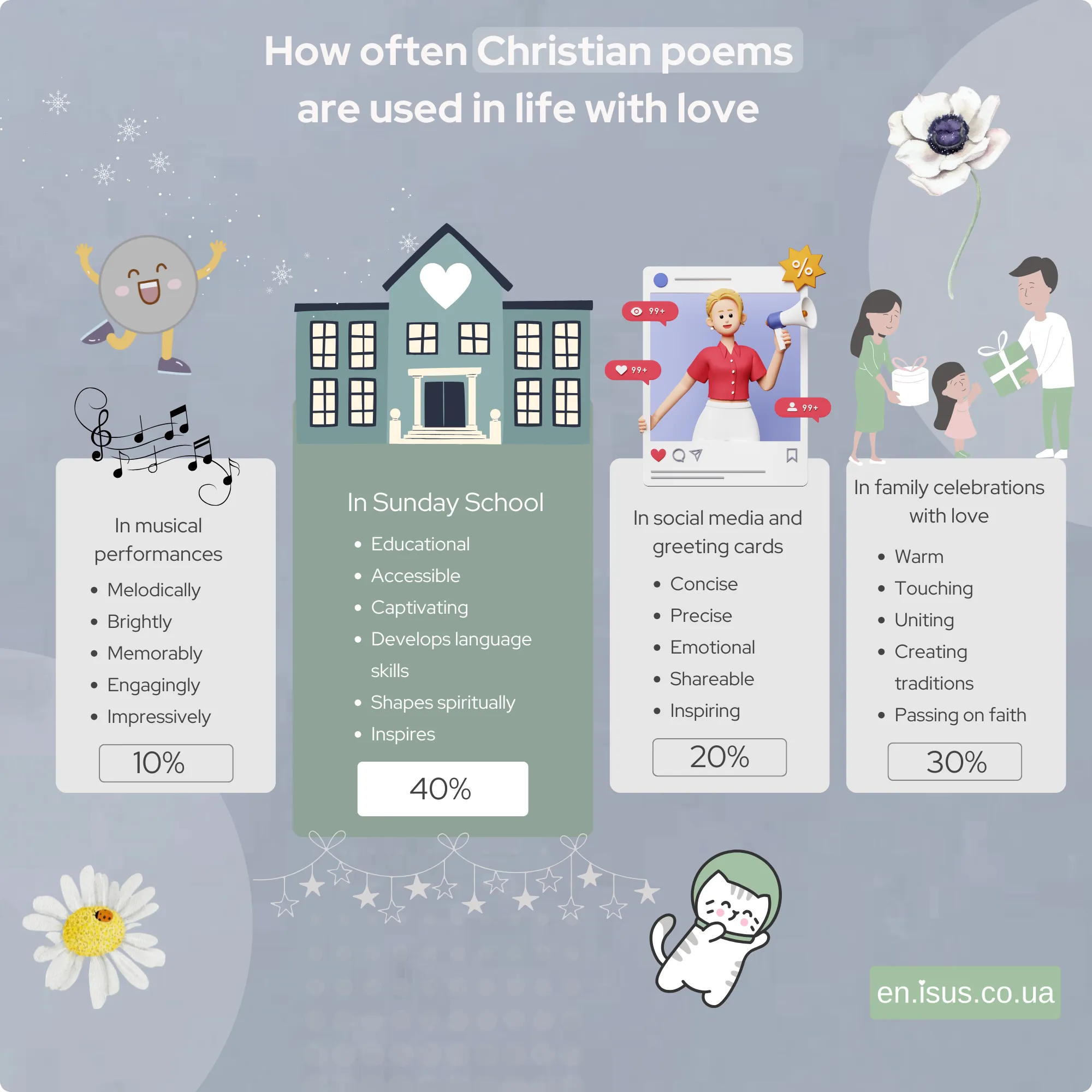
A Christian poem is more than poetry.
It is a gentle word that touches the heart, a light that warms the soul, and a bridge that leads both children and adults to a deeper understanding of God.
If you want spiritual formation to be warm, vibrant, and joyful 😄, use Christian poetry not only as reading material, but as a tool for influence, growth, and inspiration.
Below are practical ways to use it.
1. In holiday events
The best way to involve children in Christmas, Easter, or Mother’s Day is to give them a poem.
It could be a solo performance, a group recitation, or even a theatrical scene.
A poem at a celebration:
- adds emotional depth to the program
- reinforces biblical truths through imagery
- helps children personally experience the occasion
Example of a short Christmas poem:
“Little Jesus sleeps in hay,
Heaven’s love lights up the way.
Gently born for each of us,
So our hearts may shine in trust.”
2. In Sunday schools and church groups
A poem can be part of a lesson, a memory task, a game, or a prayer 🙏.
Use poems:
- to reinforce biblical truths
- as part of morning circle time ⚪️
- to encourage children’s participation
It’s helpful to introduce poems by theme: about Jesus, forgiveness, thankfulness.
After reading, you can discuss imagery, draw illustrations, or create new rhymes.
Prayer-themed poem for a children’s group:
“I will pray to God each morning,
Thanking Him for love and light.
For my parents, path so glowing,
And the heavens pure and bright.”
3. In home-based spiritual formation
Reading poems together as a family is a peaceful form of spiritual dialogue.
Morning or evening, during joy or sadness – a short Christian poem can be a moment to talk about what matters.
Tips:
Make it a tradition: one poem per day;
Choose short, rhymed texts – easier to memorize;
Connect poems to daily events.
Home poem for reading with children:
“Lord, I thank You from my heart,
For Your boundless love and grace.
Each new day a beam of faith,
Helping me bring warmth and care.”
4. In blogs, videos, stories, and booklets
Short, sincere poems are a beautiful format for social media content.
They work well as:
- captions for photos 🎞️
- voiceovers for reels or nature/children’s videos
- content for digital postcards
- elements of posts with spiritual reflections
What matters:
- The poem should be meaningful, yet easy to understand
- Avoid complex religious terms in texts for children
- Pair poetry with visuals – it makes a lasting impression
Example:
“You, my God, are morning’s light,
The trembling of the heart, spring’s flight.
On a winter day, in snowy beams,
You’re my path and all my dreams.”
5. In verse-based plays and drama scenes
Christian poetry fits beautifully into dramatic performances.
These can include:
- roles of angels, shepherds, prophets
- dialogues in rhymed form
- narration written as a poem
Tips:
- Use short verses with clear rhythm
- Add movements, emotions, costumes – this enhances the impact
- Write your own texts – this lets you adapt them for different age groups
Excerpt from a poetic scene:
“I’m a shepherd boy, small and kind,
Walking with my pipe in morning light.
Suddenly the sky did sing
And bright glory covered everything.
An angel said: “Fear not, dear child,
In Bethlehem a wonder shines.
A Savior’s born – holy and true,
Whose love will embrace the world and you.”
Christian poetry is a source of inspiration, a tool for formation, and a space for creativity.
Use it with love, joy, and a desire to share the light of God’s Word.
Creating Your Own Christian Poetry
For adults 👱♂️: how to express faith through rhyme
Christian poetry is more than a literary form.
It’s a way to say “thank You” to God, to share the light of hope, love, and eternity with others.
Even if you’ve never written a poem before, that’s no reason to stop.
God does not require perfect rhyme – He values a sincere heart 🤍.
Inspiration from Scripture
To begin writing, open the Holy Bible.
One verse from Psalms, the Gospels, or Proverbs can become the foundation of a poetic line.
For example, the phrase “The Lord is my Shepherd” may inspire a poem about trusting God in hard times.
A practical tip: start with one short Bible verse and respond to it with a four-line poem – like a prayer in reply.
Writing from the heart without experience
- Don’t try to invent “beautiful” words
- Write down the first thing your heart tells you
- Imagine you’re writing a letter to Jesus or someone searching for hope
- Read it aloud – listen if it sounds honest
The form can be free.
Don’t worry about stress or perfect rhythm.
A word written with love sounds harmonious even in imperfect rhyme.
The goal: not beauty – but sincerity
Christian poetry is not a competition.
The main thing is truth that touches the soul.
Your poem might not win awards, but it may change someone’s day.
Or life.
Insights:
- People respond better to simple words with deep meaning
- Poems written in tears or prayer are read with reverence
- You can give a poem in a card, write it by hand, or share it online – and it will be an act of goodness
For children: how to write a poem together
Christian poetry is a beautiful way to encourage a child to think about God, create, and share.
It’s not a school assignment.
It’s a game, a prayer, creativity, and learning all in one.
Simple rhyme techniques
Start with the easiest form:
- Rhymes like “ayay-ightight”:
“Little Jesus sleeps in hay,
Love is shining in this way.
He smiles gently in the light,
Like a star that shines at night.” - Use familiar words: heaven 🌅, mother, Jesus, light, good
- Create the rhyme together: the adult says the first line, the child completes it
Tips:
- Keep it to four lines the first time
- Don’t correct – encourage
- Praise the effort, not the result
Imagination exercises and biblical images
Invite the child to imagine a scene from the Bible.
For example:
- An angel singing on Christmas night
- Jesus petting a lamb
- God’s hand holding our little hand
Let the child describe what they see, and together turn it into a simple poem.
Interactive formats: “finish the rhyme,” “draw the poem” 🎨.
- The adult reads a line and the child invents a rhyme
- Create a “poem puzzle” – print the lines and let the child arrange them
- Draw the poem: one picture for each line
- Play: “Build the angel’s poem,” “A poem for little Jesus.”
This not only develops memory and speech.
It plants the Word of God in the child’s heart with love – a love they will remember for a lifetime.
Remember: you are a guide.
You don’t need to be a poet to sow faith in words.
You just need to be near, to listen, to inspire – and to believe alongside the child, lighting the way with God’s Word.
Advice for parents, educators, and mentors
How poems can encourage reading the Bible
A poem is a gentle bridge 🌈 to the great Book 📖.
For a child or someone new to faith, the Bible may seem overwhelming.
But a simple Christian poem, written with love, opens the heart and prepares it to receive God’s Word.
When a poem includes the names of biblical figures, phrases from Scripture, or images from Jesus’ parables, it sparks curiosity.
This naturally awakens a desire to learn more.
What you can do:
- after reading the poem, say: “Would you like to know what happened next?”
- invite the child to find the mentioned story in the Bible (for example, about David or the birth of Jesus)
- draw an illustration together based on the biblical scene mentioned in the poem
- compare the poem’s lines with a Bible passage: find what’s shared and discover something new
- use the poem as a prayer or as an introduction to reading
How to work with poems in a group or at home
Poems help create an atmosphere of love, peace, and shared joy.
In clubs, during lessons, and at home – poetry sounds like the music of the heart.
Practical tools:
- start a lesson with a short prayer poem – it gently tunes the child’s heart to listen
- play with rhymes – divide a poem into lines and let the children arrange them in the correct order
- create a poetic performance – children can act out the poem with roles
- use illustrations – ask them to draw a picture inspired by the poem and discuss its meaning
- recall a life situation that resonates with the poem – this helps the child apply faith in daily life
- create a “poetry wall” at home or in class – post a new poem every week
Advice for Sunday school teachers
Sunday school is a space for spiritual growth through gentle words.
Here, poems are not just decoration, but tools for nurturing the soul.
Recommendations:
- choose poems that match the lesson’s theme – this helps the child remember the key message
- let children read poems aloud – it builds confidence and courage
- share the story behind the poem or its author – this nurtures curiosity and respect
- when preparing for holidays (Christmas, Easter), create selections of poems so each child can choose one
- encourage children to write a short poem of their own – even just two lines is a personal testimony of faith
Advice for parents who don’t feel confident as spiritual guides
You don’t need to be a theologian to teach a child to believe.
Love ❤️, sincerity, and the desire to share simple moments – that’s more than enough.
Poetry is one of the most beautiful ways to begin.
Practical steps:
- read a poem before bedtime – it brings peace and ends the day with spiritual warmth
- print out a poem and hang it on the fridge or in the child’s room – let their eyes see kind words every day
- learn a poem together – not as a task, but as a game, a song, a moment of closeness
- choose short poems – just 2 to 4 lines can plant a seed of faith in the heart
- share poems with other parents and friends – faith grows through community
What matters most is not being perfect, but being present.
One good poem read together can give more than dozens of textbooks.
Your kindness and sincerity are the best Bible your child will ever read.
Poem collections
The Best Christian Poems for Christmas ✨
Christmas is more than just a date it’s the embrace of God’s love.
Warm words born from the heart help children and adults grasp the meaning of this radiant day.
Below are simple, sincere verses you can share at a celebration, during family reading, or as a greeting.
“Silent Night, So Still“
Silent night, so still and bright,
A star above gives gentle light.
The child in manger softly sleeps,
While heaven’s song around Him weeps.
Sweet Mary holds Him close and warm,
While angels guard Him from all harm.
And from the skies there comes a sound
A song of praise the stars resound.
“The Angels Sang“
The angels sang in silent skies,
Their voices echoed, pure and wise.
“Glory to God!” their chorus soared,
“Peace to the earth from Christ the Lord!”
The shepherds bowed with hearts so mild,
Their steps were drawn toward the Child.
For Hope and Love in Him did dwell
The Savior came, Emmanuel.
“The Christmas Star“
The Christmas star began to rise,
With gentle hope it lit the skies.
Not born in halls of gilded pride,
But in a manger, meek, He cried.
This star still shines through every night,
With love, and peace, and guiding light.
He walks with us through joy and strife
The King is born to bring us life.
Short Christmas Poems for Children
These short verses are easy to learn and perfect for little voices at home, in groups, or in cards.
“Baby Jesus”
Baby Jesus, born so small,
Lights the heart and loves us all.
“Prayer”
Lord, I love You, this I pray,
And keep You in my heart each day.
“The Light”
Jesus shines like sun above,
He fills the world with perfect love.
Poems About Jesus
These are ideal for faith lessons, deeper talks, or quiet inspiration.
Adapt them for any age.
“Heaven’s Touch”
When I read Your holy word,
I feel the stars through silence stirred.
Your voice, O Jesus, soft and true,
Brings peace and hope in all I do.
In You I find both grace and light,
Forgiveness deep, and rest at night.
I lean on You, my soul’s delight
My Way, my Truth, my Life so bright.
“He Did Not Forget”
When all the world seems dark and cold,
When nights are long and days feel old
Remember: Love once bore our sin,
And hung on cross, the world to win.
“Jesus, My Savior“
Jesus is more than just a name,
He whispers softly through my flame.
My Savior through both dark and light,
He walks beside me day and night.
If I should fall, He lifts me high,
His love restores, His grace is nigh.
He won’t depart, in time or pain
He’s always near… and will remain.
Poems About Prayer
Prayer is the breath of the soul.
These verses are perfect for bedtime, group gatherings, or spiritual lessons.
“Morning Prayer”
Thank You, Lord, for morning’s song,
For light, and sky, and bread so strong.
“Heart’s Whisper”
My prayer’s not words alone to say
It’s what my heart to You will pray.
Poems for Thematic Holidays and Clubs
These poems help create an atmosphere of love and spirituality during events like Christmas, Easter, and Mother’s Day.
“Mother’s Day”
Thank You for my mom, so dear,
Who teaches love and heartfelt prayer.
She’s like an angel always near,
Beside me in each work and care.
“Easter Morning”
Christ is risen! The world rejoices!
Gone is the shadow, gone the sorrow.
He conquered sin, defeated death,
And gave mankind eternal breath.
You can print these selections, include them in festive programs, send them to friends, share them on social media (with credit to our site), or compile a little collection for your child.
Poetry is one of the gentlest threads by which God touches the heart.
Conclusion about Christian poems and rhymes
Christian poetry is not merely verse, but a living prayer spoken in the rhythm of the heart.
These are words that don’t pass unnoticed but remain within the soul.
They are bright seeds you plant in a child’s heart or your own and over time, they grow into kindness, gentleness, and faith.
Through poems, God tenderly reaches hearts with words that are simple, clear, and meant for everyone.
In today’s world, full of noise and worry, Christian poetry carries special value.
It nurtures a culture of love, light ☀️, and mercy.
Poems teach us to see the unseen to find God’s care in the ordinary, His strength in our weakness, and His tenderness in silence.
Through them, children learn more than rhyme they take in truths that shape their character.
And adults remember how it feels to trust and to rejoice in the simple.
Even a small verse spoken with faith can change someone’s day.
It can comfort, support, guide, or even heal.
That’s why every poetic word you share with a child, a family, a group, or the world is more than text.
It’s a ray of warmth.
It’s a speck of light that can be remembered, quoted, carried in the heart.
A Christian poem is like a prayer drawn in a child’s picture, a smile of an angel on a page.
It’s not for entertainment.
It’s for the soul.
It’s for God.
We invite you to read, write, and share Christian poetry.
Let it become part of your ministry, your family time, your teaching, your posts, or even a small note to a friend.
The world 🌍 needs more kind words and you can be the one to give them 🎁.
With love ❤️.